The 51-year-old Jackson is the court’s 116th justice, and she took the place of the justice she once worked for

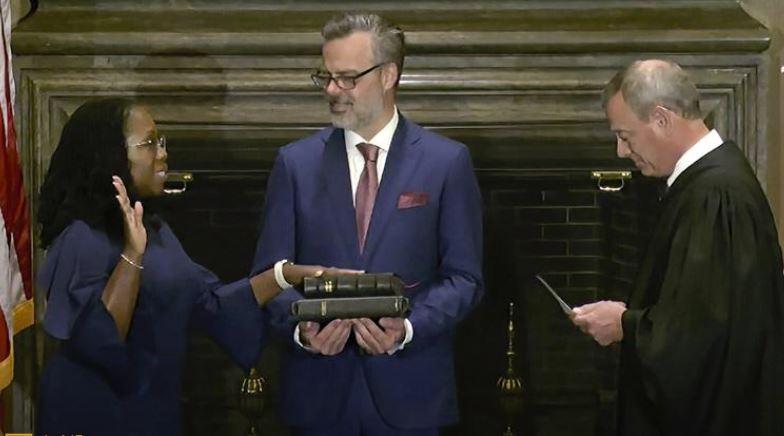
Ketanji Brown Jackson was sworn in to the Supreme Court on Thursday, shattering a glass ceiling as the first Black woman on the nation’s highest court.
The 51-year-old Jackson is the court’s 116th justice, and she took the place of the justice she once worked for. Justice Stephen Breyer’s retirement was effective at noon.
Moments later, joined by her family, Jackson recited the two oaths required of Supreme Court justices, one administered by Breyer and the other by Chief Justice John Roberts.
“With a full heart, I accept the solemn responsibility of supporting and defending the Constitution of the United States and administering justice without fear or favor, so help me God,” Jackson said in a statement issued by the court. “I am truly grateful to be part of the promise of our great Nation. I extend my sincerest thanks to all of my new colleagues for their warm and gracious welcome.”
Roberts welcomed Jackson “to the court and our common calling.” The ceremony was streamed live on the court’s website.
Jackson, a federal judge since 2013, is joining three other women — Justices Sonia Sotomayor, Elena Kagan and Amy Coney Barrett. It’s the first time four women will serve together on the nine-member court.
Biden nominated Jackson in February, a month after Breyer, 83, announced he would retire at the end of the court’s term, assuming his successor had been confirmed. Breyer’s earlier-than-usual announcement and the condition he attached was a recognition of the Democrats’ tenuous hold on the Senate in an era of hyper-partisanship, especially surrounding federal judgeships.
The Senate confirmed Jackson’s nomination in early April, by a 53-47 mostly party-line vote that included support from three Republicans.
Jackson had been in a sort of judicial limbo since, remaining a judge on the federal appeals court in Washington, D.C., but not hearing any cases. Biden elevated her to that court from the district judgeship to which she was appointed by President Barack Obama.
Glynda Carr, president of Higher Heights for America, an organization that advocates for the growth of Black women’s political power, said the timing of Jackson’s swearing-in was bittersweet.
“Although we celebrate her today, one Black woman or a cohort of Black women can’t save this democracy alone. We are a piece of it and we are doing our work, our part. She’s going to forever reshape and shape that court. But she’s just a piece of the work that needs to happen moving forward,” Carr said.
Because of Jackson’s appointment, Judith Browne Dianis, a Black lawyer in Washington, said she intends to end her protest against joining the Supreme Court Bar. She started it when Justice Clarence Thomas was confirmed in 1991. She said that even the series of conservative rulings from the court over the past week cannot take away from the significance of Thursday’s ceremony.
“This is a momentous occasion and it’s still a beautiful moment,” said Dianis, executive director of the civil rights group Advancement Project.
But, Dianis added, “she’s joining the court at a time when conservatives are holding the line and trying to actually take us back, because they see the progress that’s being made in our country. It’s like the Civil War that never ended. That’s the court that she’s joining.”
Jackson will be able to begin work immediately, but the court will have just finished the bulk of its work until the fall, apart from emergency appeals that occasionally arise. That will give her time to settle in and familiarize herself with the roughly two dozen cases the court already has agreed to hear starting in October as well as hundreds of appeals that will pile up over the summer.
She helps form the most diverse court in its 232-year history and is the first former public defender to be a justice. The court that Jackson is joining is the most conservative than it has been since the 1930s. She is likely to be on the losing end of important cases, which could include examinations of the role of race in college admissions, congressional redistricting and voting rights that the court, with its 6-3 conservative majority, will take up next term.
Today’s court now is surrounded by securing fencing, and justices and their families have 24-hour protection by the U.S. Marshals, the result of a law passed days after a man carrying a gun, knife and zip ties was arrested near Justice Brett Kavanaugh’s Maryland house after threatening to kill the justice. The bill was introduced in May shortly after the leak of a draft court opinion that would overrule Roe v. Wade and sharply curtail abortion rights in roughly half the states.
The court issued final opinions earlier Thursday after a momentous and rancorous term that included overturning Roe v. Wade’s guarantee of the right to an abortion. One of Thursday’s decisions limited how the Environmental Protection Agency can use the nation’s main anti-air pollution law to reduce carbon dioxide emissions from power plants, a blow to the fight against climate change.
SOURCE: AP NEWS

Tesla unveils next generation Roadster sports EV with SpaceX thrusters
- 6 hours ago

Microsoft and Japan took down a cybercrime network behind over a billion scam messages
- 9 hours ago

KFC picks Coca-Cola as US soda supplier, ditches longtime partner PepsiCo
- 7 hours ago

The AI race is back on
- 9 hours ago

Pakistan warns India against any misadventure: FO
- 3 hours ago
Trump is taking his midterms anger out on Ukraine
- 16 hours ago

Indian police detain 'cockroach' movement founder Dipke ahead of protest
- 4 hours ago

Your flu shot can’t wait
- 16 hours ago

The Fitbit Edge is for folks who don’t want to go totally screenless
- 9 hours ago

Jodar apologises for swearing at ball kid in Shanghai
- 2 hours ago

Microsoft’s new AI chip makes it less reliant on Nvidia’s GPUs
- 9 hours ago

Halo’s co-creator wrote a novel about AI taking over the world
- 9 hours ago