- Home
- Technology
- News
Europe's police keep wary eye on threat from 3D-printed guns
"3D printing is unlikely to be the future of terrorism for now"

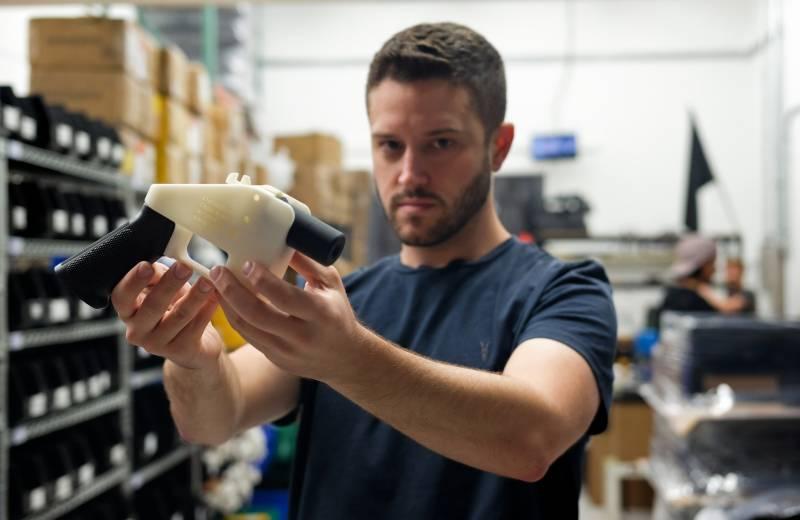
The Hague: A growing number of seizures of guns made at home from 3D-printed parts are raising alarm bells for European police over an emerging threat.
For now, interest among far-right activists may be limited, say analysts -- and fears of a society awash with print-it-yourself weapons remain far-fetched.
But homemade guns have become more widespread since 2013, when a US weapons enthusiast first showed off a mostly 3D-printed pistol and shared its design online.
Only in September, Icelandic police said they had arrested four people suspected of planning a "terrorist attack", confiscating several 3D-printed semi-automatic weapons.
The same month, Spanish authorities discovered an illegal gun-making workshop of a man in his forties in the Basque Country.
That find followed two other such cases in the country in 2021.
Police in Spain's Canary Islands found white supremacist literature and manuals on urban guerrilla warfare alongside two 3D printers.
And in the northwestern city of A Coruna, police discovered a man close to completing a scratch-built assault rifle.
"Rapidly evolving advanced technology may cause this to emerge as a more significant threat in the near future," said Ina Mihaylova, a spokeswoman for European police agency Europol.
While traditional weapons are easily traceable thanks to their serial numbers and proof marks, these "home-printed" models are less easy for the authorities to track.
- Focus on far-right -
For the moment, "there is still a big difference between the quality of the professionally manufactured weapons available on the criminal market and 3D-printed/self-made weapons," Mihaylova said.
"3D-printed firearms entirely made out of plastics usually cannot resist the pressure from live-firing ammunition," she added. They require barrels, chambers or firing pins made of metal.
But Christian Goblas, a ballistics expert at France's University of Rouen, said "3D metallic printing" could become affordable in the next decade -- which could make self-made weapons more durable and reliable.
With its 3D parts and metal firing pin, the 2013 "Liberator" pistol showed off in 2013 by self-described "crypto-anarchist" Cody Wilson aped a crude single-shot weapon of the same name air-dropped to French resistance fighters during World War II.
Wilson posted instructions for the weapon online, sparking alarm in the United States with its already lax gun control and history of deadly mass shootings.
Since then, 3D printers have become cheaper, and more blueprints have been posted on the so-called Dark Web.
Rajan Basra, a senior research fellow at the London-based International Centre for the Study of Radicalisation (ICSR), nevertheless said 3D-weapon printing remained mostly a curiosity for firearms fans or libertarians.
Even in countries with tough gun restrictions, there are better options for people seeking a firearm: In France, you can get a Kalashnikov assault rifle on the black market for between 500 and 1,500 euros ($485-$1460).
To a lesser degree, DIY guns are also attractive to "terrorists", far-right militants and gangsters, Basra added.
Eleven out of 12 recent seizures in Europe implicated far-right activists, he pointed out.
- Not 'the future of terrorism' -
One of the highest-profile uses of weapons with 3D-printed parts came in Germany in 2019.
A gunman killed two people in the eastern city of Halle after failing to break into a synagogue. Before the attack, he had posted a racist, misogynistic and anti-Semitic manifesto online.
A video the attacker made of his rampage showed him repeatedly struggling with weapon jams.
"At least I've demonstrated how useless improvised weapons are," he could be heard saying at one point.
Blyth Crawford, another researcher at the ICSR, said the attack was an exceptional case.
In online discussions among some far-right extremists, "3D printed firearms are not yet regarded as a serious alternative to regular guns for carrying out a mass shooting, as they are regarded as comparatively untested," he said.
Jacob Ware, a counter-terrorism researcher at the Council on Foreign Relations, agreed that not all such extremists were enthusiastic about the labour-intensive way of making a gun.
For some, it was "fundamentally game-changing in opening new doors for terrorists without access to firearms".
But others mocked the technology "as only relevant for those who have failed to stockpile weaponry in preparation for... government tyranny".
Extremists might see other new technologies such as drones as more promising for their ends.
"3D printing is unlikely to be the future of terrorism for now," Ware said.
However, "legal systems should be getting ahead... to ensure gun control regulations are not circumvented before it is too late", he added.
SOURCE: AFP

Solar manufacturing policy needs to unlock jobs, exports: Punjab governor
- 6 hours ago
Why Trump’s Latino voters are fleeing him
- 18 hours ago

Can AI actually save lives?
- 18 hours ago
Waymo is offering transit discounts again, this time with Visa
- 20 hours ago

WHO renews commitment to support Pakistan in fight against childhood cancer
- 5 hours ago

Meta patches Muse exploit that let attackers control the AI agent
- 20 hours ago
Security forces kill 33 terrorists in Balochistan: ISPR
- 3 hours ago

Your questions about the AI apocalypse, answered
- 18 hours ago
Trump is bracing to lose his latest fight with the press
- 18 hours ago

PM reiterates Pakistan’s attachment to purposes, principles of UN Charter
- 9 hours ago

PTI decides to postpone planned Sept 27 long march
- 8 hours ago

Pakistan, KSA, Türkiye review progress on Makkah Joint Defence Agreement
- 5 hours ago