The Apple Vision Pro has a very good display. That’s the big takeaway from iFixit’s second teardown video on the headset (with accompanying blog), as the team found the dual MicroOLED panels inside are the densest they’ve ever seen at 3,386 pixels per inch (ppi). That doesn’t quite put the Vision Pro at 4K resolution, but it’s close. (iFixit notes that the consumer standard for 4K UHD is 3,840.) This is the benefit of using MicroOLED and is also a huge part of why the Vision Pro is so costly.
Technology
- Home
- Technology
- News
A new Vision Pro teardown shows Apple’s incredible pixel density
The Apple Vision Pro features displays with an impressive 3,386ppi, as shown in iFixit’s teardown of the headset that focuses on its MicroOLED, sensors, and battery.

Published 3 سال قبل on فروری 9 2024، 10:00 صبح
By Web Desk
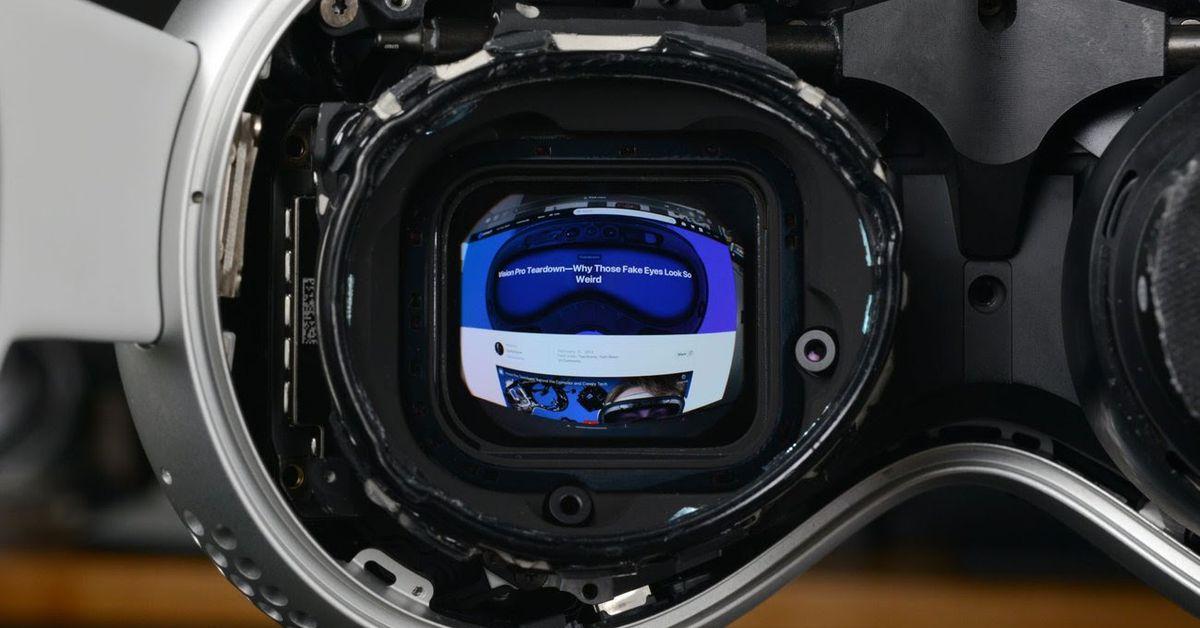
Compared to other VR headsets, there’s no contest here. iFixit points out that the Meta Quest 3 sits at about 1,218ppi, while the HTC Vive Pro is even less dense at around 950ppi. And your average phone is only going to be in the mid-100s. (iFixit notes the 15 Pro Max is at 460ppi.)


But as iFixit also writes, pixels per degree is an important number — your eyes are so close to the screen that things can get pixelated as you look over to the side of the screen when the number of horizontal pixels per degree (ppd) of viewing angle is low enough. iFixit says it estimates the Vision Pro to be about 34ppd, which is lower than the 94 and 95ppd ratings you’d see in the iPhone 15 Pro Max at a foot away or a standard 65-inch 4K TV at 6.5 feet away, respectively.
Looking at the battery pack, iFixit found that Apple appears to be limiting the charge to about 80 percent of the total actual capacity, finding that the three roughly iPhone-size batteries packed inside have a total 46.08Wh capacity. (Apple labels it as 35.9Wh.) The big Lightning connector is used to output a non-USB standard 13 volts, and iFixit also found the accelerometer that activates the pack’s charge LED as well as temperature sensors, which could also help keep it from getting uncomfortably hot while in users’ pockets.
The team also published findings on the chips inside the Vision Pro and discussed the many sensors it has inside and out to monitor the wearer’s face, hands, and surroundings. iFixit noted that the Vision Pro has some modularity, including the battery and the headset straps as well as the light seal cushion. But when it comes to getting into the Vision Pro, it takes “a lot of careful finessing with a heat gun and multiple prying tools” to get it apart without damaging it.

OpenAI is stepping back from NDAs for data center projects
- 4 hours ago

Train collision in Egypt’s Giza province kills four and injures 88, health ministry says
- a day ago

Binance says hackers used fake job interviews and an internal AI tool to pull off the $6.3 billion heist
- a day ago

How Democrats can make good on their new mandate
- 17 hours ago

Please stop asking me when the AI bubble will pop
- 4 hours ago

Week-long polio campaign ends with 24mn children vaccinated
- a day ago

PML-N candidate Asad Hanif Jutt wins PP-203 Chichawatni by-election
- a day ago

Qualcomm is betting big on data centers as smartphone sales sink
- 19 hours ago
Here’s what it’s like to use Audio Intelligence on the Apple Watch
- a day ago

Canva is announcing changes and layoffs affecting 22 percent of its staff
- 4 hours ago

Jhelum DC removed over attempt to postpone exam for 'VIP visit'
- a day ago
Gemini for Home now plugs into AT&T’s smart security system
- 19 hours ago
You May Like
Trending