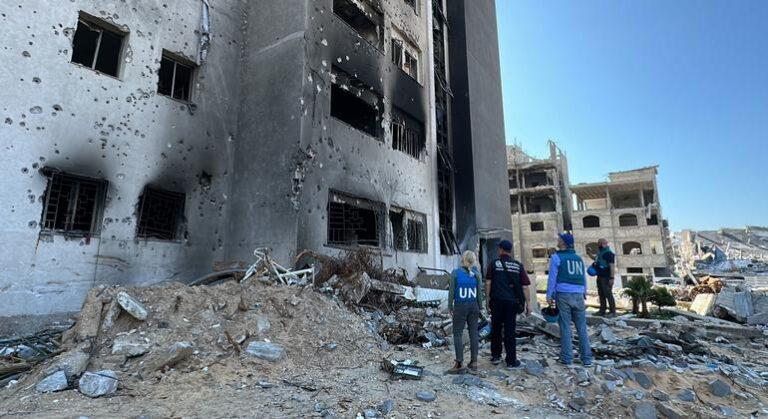
Pehr Lodhammar, a senior officer from the United Nations Mine Action Service (UNMAS), says the conflict had left an estimated 37 million tonnes of debris.

New York: Making Gaza safe again from the unexploded bombs rained down by the Israeli war machine could take 14 years, UN demining experts said Friday.
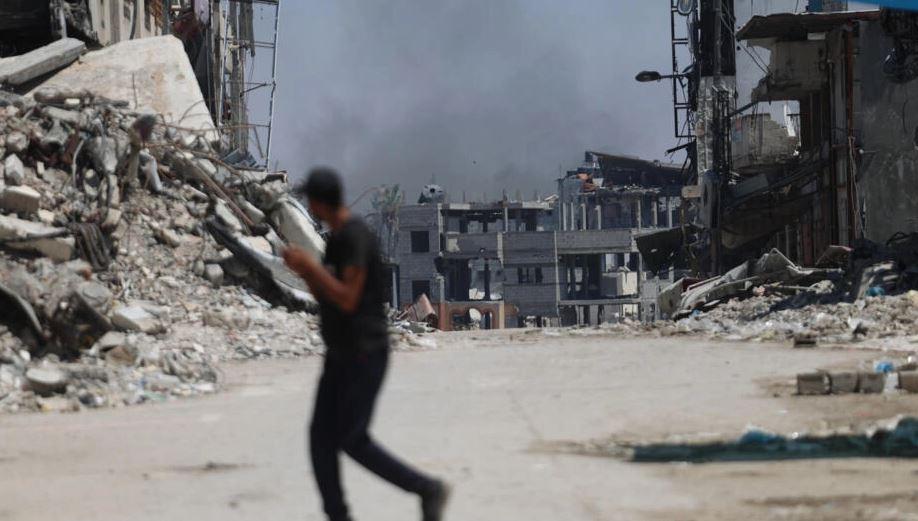
Pehr Lodhammar, a senior officer from the United Nations Mine Action Service (UNMAS), said that the conflict had left an estimated 37 million tonnes of debris.
He said it was impossible to determine the exact amount of unexploded ordnance in the enclave where formerly heavily built-up and densely populated neighbourhoods had been reduced to rubble, after nearly seven months of intense Israeli bombardment.
Every square metre in Gaza impacted by the Israeli attacks contained some 200 kilogrammes of rubble, the veteran UN demining expert told journalists in Geneva. “All I can say is that at least 10 per cent of the ammunition that is being fired potentially fails to function…with 100 trucks we’re talking about 14 years of work with 100 trucks, so that’s 14 years to remove with about 750,000 workdays – person workdays – to remove the debris.”
Meanwhile, UN humanitarians repeated warnings that famine is imminent in the northern Gaza Strip, in a renewed urgent appeal for more aid relief to be allowed into the enclave. Israel pledged three weeks ago to improve aid access via the Erez Crossing just north of Gaza and Ashdod cargo port, further northwards.
The UN World Food Programme (WFP) said that a small increase in aid had happened, but not nearly enough in volume – or diversity. “We’re still heading towards a famine, we haven’t seen that paradigm shift that’s needed to avert a famine, we need more volume, more predictability and a sustained effort to get more diverse assistance into the north,” said Carl Skau, WFP Deputy Executive Director.
Amid reports of sustained Israeli strikes on eastern Rafah, Skau underlined continuing deep concerns that any ground invasion of the enclave’s southernmost city risked disrupting already insufficient aid distributions.
And turning to efforts to establish a marine corridor for humanitarian aid, the WFP official insisted that “there is no substitute for land” deliveries into Gaza. In a related development, top rights experts have appealed to Israel for safe passage for a flotilla of boats carrying humanitarian aid to Gaza.
The “Freedom Flotilla” plans to depart from Türkiye carrying 5,500 tonnes of aid, along with hundreds of international humanitarian observers, en route for the besieged Gaza Strip.
“As the Freedom Flotilla approaches Palestinian territorial waters off Gaza, Israel must adhere to international law, including recent orders from the International Court of Justice (ICJ) to ensure unimpeded access for humanitarian aid,” said the experts, who include Michael Fakhri, Special Rapporteur on the right to food.
In 2010, the experts noted that Israel intercepted and attacked the Freedom Flotilla’s civilian ships in international waters, killing 10 passengers and wounding many others.
At the time, the Freedom Flotilla had attempted to break the Israeli blockade by delivering humanitarian aid to Palestinians in Gaza.

How both parties have changed since 2024
- 14 hours ago

Amazon’s delivery driver smart glasses will reportedly take photos ‘almost constantly’
- 17 hours ago

India beat West Indies by eight wickets in first T20
- 6 hours ago

Trump’s plan to buy votes, briefly explained
- 15 hours ago

Reverse-engineered games: All the news on video game decomps, recomps, VR and web and 3D ports
- 16 hours ago
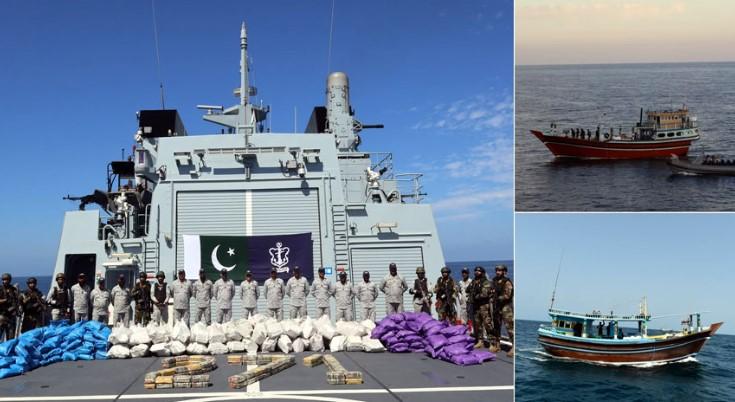
Pakistan Navy conducts two counter-narcotics operations in Arabian Sea, seizes huge quantity of narcotics
- 3 hours ago

The Matic is the first robovac to get an FCC ban waiver, not that it needs it
- 16 hours ago

Noise from Universal’s latest ride made rich locals furious, fast
- 17 hours ago

What you should know about the Russian “plague lab”
- 15 hours ago

Kagan and Soai win 2026 Nobel chemistry prize
- 6 hours ago

Apple’s new M6 Mac Mini is over $100 off
- 16 hours ago

Mike Flanagan reimagines 'Carrie' for new generation facing cyberbullying, active shooter drills
- 6 hours ago