
Scientists are dropping live mosquitoes out of drones in Hawaii. Here’s why.
It sounds like something out of a nightmare: a giant drone flying through the sky and dropping containers full of live, buzzing mosquitoes, one of the world’s most hated insects. But in Hawaii, this scenario is very much real. A remotely operated aircraft, ab…

Published a year ago on Jun 19th 2025, 7:00 am
By Web Desk
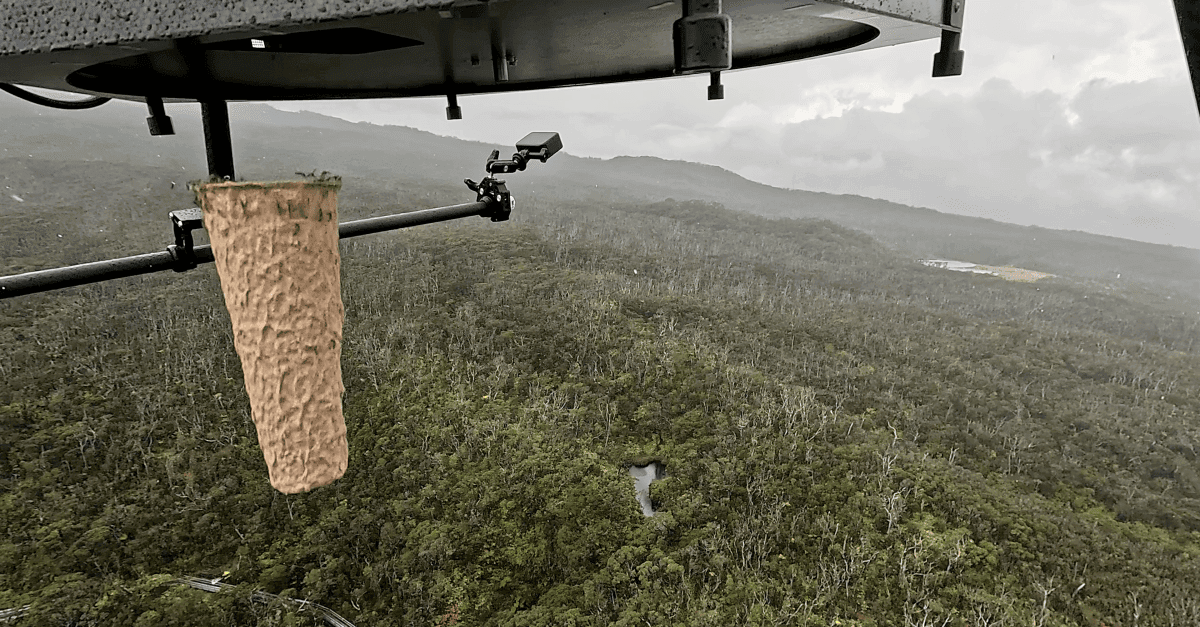
It sounds like something out of a nightmare: a giant drone flying through the sky and dropping containers full of live, buzzing mosquitoes, one of the world’s most hated insects.
But in Hawaii, this scenario is very much real. A remotely operated aircraft, about 8 feet long, is flying over remote forests in Maui and releasing cup-shaped capsules full of mosquitoes.
As scary as it might sound, the project is a clever solution to a problem that has long plagued the Hawaiian islands.
Hawaii faces an extinction crisis: It has lost hundreds of animals in the last two centuries, including dozens of land snails and birds, largely due to the spread of non-native species like stray cats and feral pigs. Many native animals found nowhere else on Earth are now gone for good. And several of the creatures that remain are heading in the same direction. Scientists on the islands are quite literally racing to save what wildlife remains.
For the state’s avian species — its iconic forest birds, significant, too, to Indigenous Hawaiian culture — the main force of extinction is malaria, a mosquito-borne disease. Mosquitoes, a nonnative pest, were introduced accidentally in the early 1800s by a whaling ship. The blood-suckers proliferated across the islands and later began spreading avian malaria, a blood-borne pathogen they transmit through their bites.
[Image: https://platform.vox.com/wp-content/uploads/sites/2/2025/06/Akikiki_Robby-Kohley_AmericanBirdConservancy.jpg?quality=90&strip=all]
[Image: https://platform.vox.com/wp-content/uploads/sites/2/2025/06/Kiwikiu_Robby-Kohley_AmericanBirdConservancy.jpg?quality=90&strip=all]
The disease, which can be fatal, utterly devastated the state’s forest birds, and especially a group of species in the finch family known as honeycreepers. There were once more than 50 species of these colorful songbirds across Hawaii, and today all but 17 are extinct. As I’ve observed firsthand, the forests here have grown silent.
The few honeycreeper species that persist today have been able to evade malaria largely because they live in higher elevations that are too cold for mosquitoes. But now, climate change is warming the islands, allowing the insects to march uphill into the remaining avian strongholds. Some experts describe this as an “extinction conveyor belt.”
Saving these birds is quite literally a race against the clock. That’s where the drone comes in.
Fighting mosquitoes with mosquitoes
For more than a year now, a group of environmental organizations have been dropping biodegradable containers of mosquitoes into honeycreeper habitats on Maui and Kauai from helicopters. Now they’re starting to do it with giant drones. The containers fall to the ground without a top, and when they land the insects escape into the forest.
Critically, these are not your typical mosquitoes. They’re all males, which don’t bite, that have been reared in a lab. More importantly, they contain a strain of bacteria called wolbachia that interferes with reproduction: When those males mate with females in the area, their eggs fail to hatch. (That’s thanks to a bit of biology magic, referred to as the incompatible insect technique, or IIT.)
[Image: Researchers test out aerial mosquito releases using a drone. https://platform.vox.com/wp-content/uploads/sites/2/2025/06/AltaX-MAHI-1st-MosquitoRelease-Insta360_2025_Adam-Knox_AmericanBirdConservancy.jpg?quality=90&strip=all]
The idea is to continually release these special males into honeycreeper habitat where malaria is spreading as a way to erode the population of biting mosquitoes — and thus suppress the spread of disease. The approach has little ecological downside, said Chris Farmer, Hawaii program director at American Bird Conservancy, a conservation group that’s leading the drone effort. Mosquitoes are not native, so local ecosystems and species don’t rely on them.
“What this does is it erects an invisible barrier so that these mosquitoes can’t get up to the forests where these birds remain,” Farmer told Vox.
Since late 2023, a coalition of organizations known as Birds, Not Mosquitoes has unleashed more than 40 million male mosquitoes across Maui and Kauai. Nearly all of those were in containers tossed out of helicopters, which allow scientists to deliver the insects to remote forest regions where the birds remain.
The group is now testing drones as an alternative. While the helicopters can carry more mosquitoes than drones in one flight — around 250,000, compared to about 23,000 — drones are safer because they’re unmanned. They’re also easier to fly on demand, says Adam Knox, the drone pilot and project manager for aerial deployment of mosquitoes at American Bird Conservancy.
Dropping mosquitoes out of drones and choppers may sound unreal, but it’s the best idea out there to help Hawaii’s honeycreepers, said Marm Kilpatrick, an avian malaria expert at the University of California Santa Cruz. Kilpatrick is not affiliated with the mosquito-release project. “The reason that it’s worth doing is that so far, we haven’t discovered anything else that can possibly do this better,” Kilpatrick told Vox.
Scientists don’t yet know if unleashing reproductively challenged mosquitoes is working and causing the resident mosquito population to crash. It’s too soon to tell and the research is still underway, according to Christa Seidl, the mosquito research and control coordinator at Maui Forest Bird Recovery Project, a group leading avian conservation on the island.
But the same approach has worked elsewhere — to stem mosquitoes that spread diseases among humans. Global health advocates have released mosquitoes with wolbachia strains that disrupt reproduction in other parts of the world and seen a massive decline in the incidence of, for example, dengue fever.
“It sounds weird to say, but we’re standing on the shoulders of human disease,” Farmer said. “The IIT we’re using for conservation was first developed for human health.”
Endgame for mosquitoes?
Ultimately, the goal is not total elimination of mosquitoes that carry avian malaria in Hawaii. That’s likely impossible, Kilpatrick said, unless scientists could release millions or even billions of lab-grown insects all at once.
For the time being, the plan is to regularly — and indefinitely — release the mosquitoes into forests with some of the most endangered birds, such as the kiwikiu, ‘ākohekohe, and ʻakekeʻe. Barring any regulatory or technical problems, drone deployments will soon be a regular part of that effort.
“This is the last chance to save most of our remaining songbirds,” Farmer said. “When we’ve succeeded, the birds will come back.”
Saudi forces say intercepted two Houthi missiles targeting Yanbu, Taif
- 4 hours ago
SpaceX will try catching Starship and its booster for first time, Musk says
- 15 hours ago

US military bans BYD vehicles from strategic air base in Japan
- a day ago

Xbox Cloud Gaming’s pay-as-you-go option starts at $3.99 for 10 hours
- 6 hours ago

How to ban gerrymandering when the Supreme Court is stacked against you
- 13 hours ago

JustWatch now streams TV shows and movies, too
- 15 hours ago

10 terrorists, including one female, killed in Gwadar: ISPR
- a day ago

Field Marshal Munir vows total defeat of terrorists with public support
- a day ago
Pakistan rejects Khalilzad's allegations of arming Afghans
- 4 hours ago

PM Shehbaz sets illustrative wheat price at Rs4,500 per 40kg for 2027
- a day ago

Colleges can do more to prevent sexual assault. Here’s where to start.
- 13 hours ago

FinMin Aurangzeb, WB discuss Pakistan's economic reform agenda
- a day ago
You May Like



Trending