The same Supreme Court that ruled that President Donald Trump is allowed to use the powers of the presidency to commit crimes finally placed a meaningful limit on Trump’s authority on Tuesday. In Trump v. Illinois, three Republican justices joined all three o…

Published 10 months ago on Dec 28th 2025, 7:00 am
By Web Desk
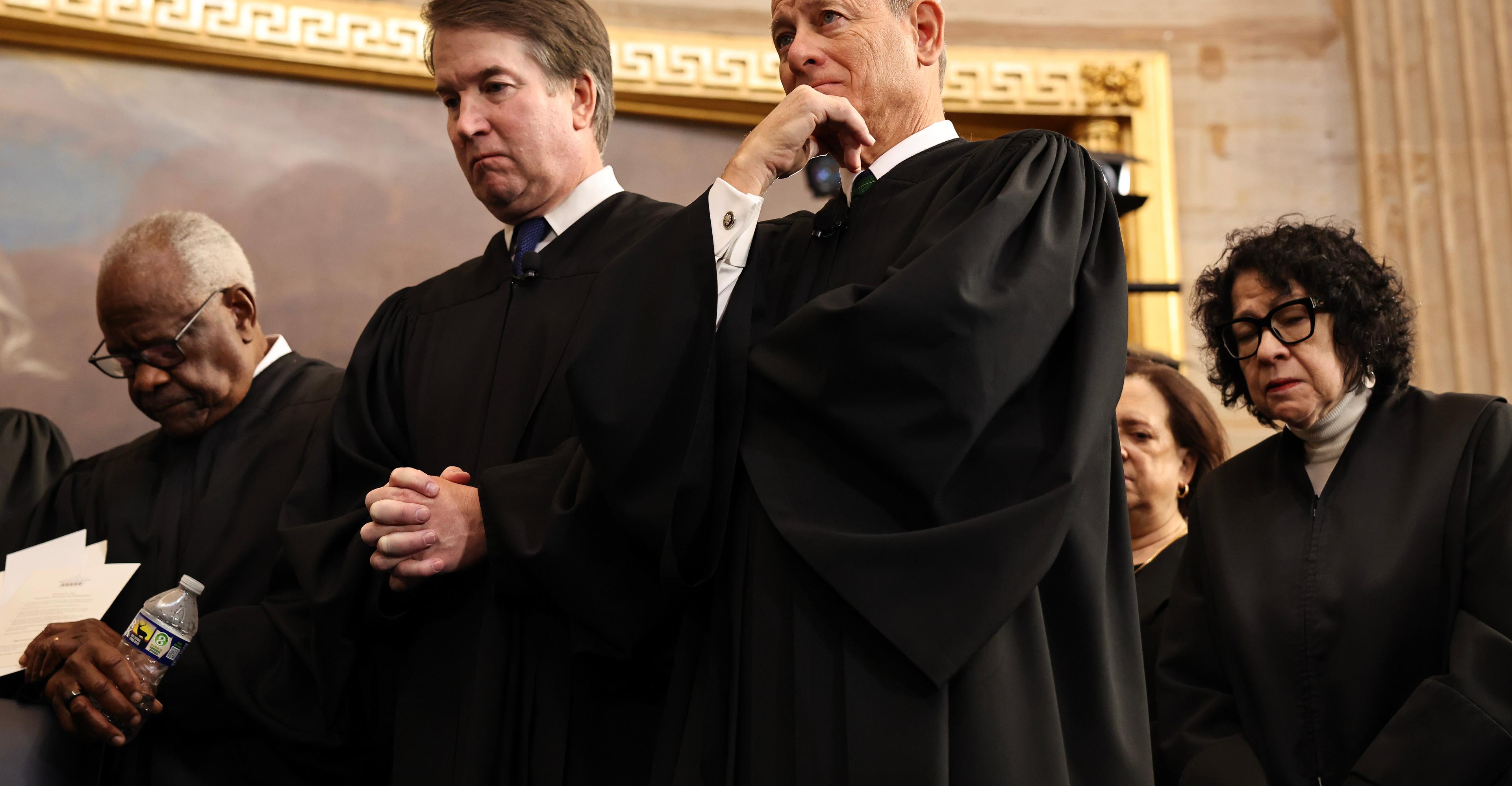
The same Supreme Court that ruled that President Donald Trump is allowed to use the powers of the presidency to commit crimes finally placed a meaningful limit on Trump’s authority on Tuesday.
In Trump v. Illinois, three Republican justices joined all three of the Court’s Democrats in ruling that Trump violated federal law when he deployed a few hundred members of the National Guard to squelch protests outside of an immigration detention facility in Broadview, Illinois, which is about 12 miles west of Chicago.
Notably, however, Justice Brett Kavanaugh wrote a separate opinion saying he would have ruled against Trump on very narrow grounds. So, it appears that only a bare majority of the justices voted to place significant limits on Trump’s authority to deploy the military against Americans located on US soil.
Trump attempted to use the military against a small number of protesters outside of the Broadview facility. According to Judge April Perry, a federal district judge who previously heard this case, “the typical number of protestors is fewer than fifty,” and “the crowd has never exceeded 200.”
Nevertheless, Trump claimed the authority to use National Guard members against this minor protest under a federal law that permits the federal government to take command of the Guard (which is ordinarily controlled by states) if there is “a rebellion or danger of a rebellion against the authority of the Government of the United States” or if “the President is unable with the regular forces to execute the laws of the United States.”
The Supreme Court’s Tuesday order does not even engage with Trump’s implausible claim that several dozen people protesting an immigration facility (some of whom have been charged with crimes) constitute a “rebellion.” Instead, it focuses largely on Trump’s claim that he could deploy the Guard because he is “unable” to execute US law without it.
The first part of the Court’s response to Trump is a bit alarming. The Court’s order explains that the words “regular forces,” as it is used by the relevant statute, “likely refers to the regular forces of the United States military.” Thus, Trump cannot use the National Guard unless he is somehow unable to enforce the law by using the full might of the United States Army, Navy, Air Force, and Marines.
This argument could be troubling, because it seems to goad Trump into actually attempting to use the regular Army or Marines on political protesters. But, the Court’s Illinois order also contains some language suggesting that his power to use the regular military is also limited.
The circumstances when Trump may do so, the Court explains, are “exceptional.” That is because a separate federal law prohibits the military from “execut[ing] the laws” outside of “cases and under circumstances expressly authorized by the Constitution or Act of Congress.” And, as the Court’s brief order notes, Trump “has not invoked a statute” that permits him to use the regular military to execute the laws.
That said, the Illinois order is unlikely to be the end of this conflict. As Kavanaugh notes in his separate opinion, Trump might attempt to deploy regular troops under the Insurrection Act, which permits the military to “suppress, in a State, any insurrection, domestic violence, unlawful combination, or conspiracy” — but only in limited circumstances.
The Justice Department has long interpreted these circumstances very narrowly. A 1964 memorandum signed by then-Deputy Attorney General Nicholas Katzenbach, for example, indicates that the Insurrection Act may only be invoked when “those engaging in violence are either acting with the approval of state authorities or have, like the Klan in the 1870s, taken over effective control of the area involved.”
It remains to be seen whether all five of the justices who joined Tuesday’s full-throated rebuke of Trump will adhere to Katzenbach’s view if Trump does attempt to use the Insurrection Act. Still, the Illinois order does strongly suggest that even this Supreme Court is suspicious of a president who claimed broad authority to use the military against Americans.
Justice Samuel Alito, the Court’s most reliable Republican partisan, wrote a dissent that would have given Trump extraordinarily broad authority to target Americans with military force. Among other things, Alito argues that all Trump needs to do to overcome the “unable with the regular forces” language in federal law is to simply say that he has “determined that the regular forces of the United States are not sufficient.” But Alito’s opinion was joined only by Justice Clarence Thomas.
Justice Neil Gorsuch also dissented, but mostly on procedural grounds.
So, the bottom line is that, at least for now, a bare majority of the Supreme Court seems to believe that Trump should not have limitless power to use military force against US citizens on US soil.
Trump is taking his midterms anger out on Ukraine
- 7 hours ago
Ukraine claims Starlink is suddenly disrupting service for its military
- 9 hours ago

My AI doppelganger tells me what to eat
- 9 hours ago
The Nothing Headphone A are half off for the first time
- 9 hours ago
US military weighs use of ‘mother of all bombs’ in potential future strikes on Iran, CNN says
- a day ago
Five terrorists killed in Washuk IBO, Balochistan: ISPR
- a day ago

National Grid Company of Pakistan unveils new brand identity as “National Grid Pakistan”
- 20 hours ago
How Apple can win the smart home
- 9 hours ago

The problem with the US surrogacy system
- 7 hours ago
Joint Session of Parliament ratifies emergency, governor’s rule in KP
- 21 hours ago

Your flu shot can’t wait
- 7 hours ago
Pakistan pursuing investment, export-led growth: FinMin Aurangzeb
- 18 hours ago
You May Like


Trending