Federal budget presented in NA:7% increase in salaries and pensions,10% rise in minimum wage proposed
A total of Rs13,350 billion has been reserved for federal and provincial distribution.For defence, Rs3 trillion has been allocated to strengthen national security.

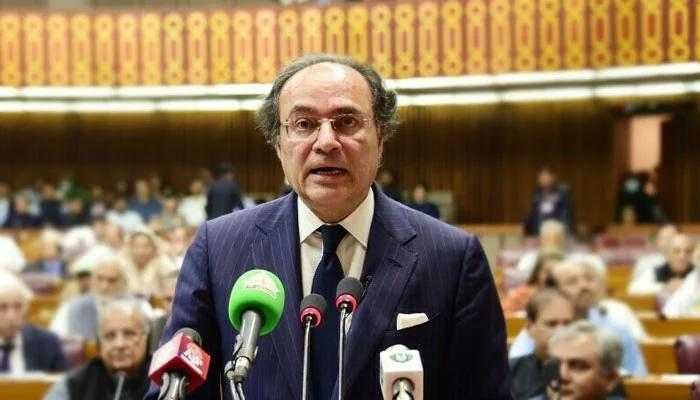
Islamabad: Federal Finance Minister Muhammad Aurangzeb has presented the federal budget for the upcoming fiscal year in the National Assembly, proposing a 7 percent increase in salaries and pensions for government employees, along with a 10 percent increase in the minimum monthly wage.
According to details, Finance Minister Muhammad Aurangzeb presented the federal budget 2026–27 in the National Assembly. In his budget speech, he said he was grateful to the Prime Minister and Bilawal Bhutto for their support in the budget-making process, adding that presenting the third budget was an honor for him.
The Finance Minister stated that Pakistan’s armed forces responded strongly to Indian aggression, and the success of Operation Bunyan-um-Marsoos is a bright chapter in the country’s history. He added that strong defence contributes to economic strength.
He also termed the strategic agreement between Pakistan and Saudi Arabia highly significant, saying Pakistan’s response to the enemy forced the world to take notice, and today the world acknowledges Pakistan’s defence capability.
He further said that under the leadership of the Prime Minister, the government has worked tirelessly to stabilize the situation and achieved several key economic milestones.
The Finance Minister stated that despite floods and the US-Iran war, Pakistan’s economic growth has reached 3.7 percent. Large-scale manufacturing production is increasing, with LSM growth recorded at 6.1 percent, while the services sector grew by 4.1 percent. He added that both LSM and services growth are at their highest levels in four years, and the size of the economy has reached $452 billion, marking a major milestone.
He further said that per capita income has increased from $1,751 last year to $1,901. In the past two years, the policy rate has seen a historic reduction, falling from 22 percent to 11.5 percent. Remittances are also reaching new record levels.
During the budget speech, the Finance Minister said that remittances reached $38 billion in the first 11 months of the fiscal year and are expected to exceed $41 billion annually, the highest level in history. He added that the tax-to-GDP ratio has increased by nearly 2 percent over the past three years, contributing to financial stability.
He further stated that the total size of the federal budget for the new fiscal year has been proposed at Rs18,771 billion, while net federal revenue is estimated at Rs11,751 billion. Non-tax revenue is projected at Rs5,336 billion.
According to the Finance Minister, the FBR tax revenue target is set at Rs15,264 billion. Out of total federal revenue, Rs8,848 billion has been allocated for provinces. A total of Rs13,350 billion has been reserved for federal and provincial distribution.
For defence, Rs3 trillion has been allocated to strengthen national security. Pension expenditures are estimated at Rs1,169 billion, while civil administration costs are set at Rs1,071 billion.
Subsidies for electricity and other sectors have been allocated Rs1,091 billion, and Rs1,100 billion has been proposed for the Public Sector Development Programme (PSDP). Rs2,680 billion has been allocated for the Benazir Income Support Programme (BISP), Azad Jammu & Kashmir, Gilgit-Baltistan, and former FATA regions. A subsidy of Rs128 billion has been announced for petroleum relief.
The Finance Minister also said that the BISP coverage will be expanded to 12 million families, with Rs838 billion allocated for the programme in the next fiscal year. Rs71 billion has been set aside for the Prime Minister’s “Apna Ghar Housing Scheme,” while Rs88 billion has been proposed under the Export Refinance Scheme to promote exports.
Custom duties on over 100 raw materials for cancer and other critical medicines have been abolished. Under the agricultural development initiative, small farmers will receive Rs300 billion in digital loans.
He further stated that a simplified fixed tax system is being proposed for small shopkeepers. Rs146 billion has been allocated for Azad Jammu & Kashmir, Rs88 billion for Gilgit-Baltistan, and Rs95 billion for newly merged districts of Khyber Pakhtunkhwa.
The government has also announced relief for salaried individuals. For those earning between Rs2.2 million and Rs3.2 million annually, the tax rate has been reduced from 23 percent to 20 percent. For incomes between Rs3.2 million and Rs4.1 million, the rate has been reduced from 30 percent to 25 percent. For Rs4.1 million to Rs5.6 million, the rate has been reduced from 35 percent to 29 percent, and for Rs5.6 million to Rs7 million, from 35 percent to 32 percent.
The government has abolished super tax across six slabs. Earlier, individuals earning between Rs150 million and Rs500 million annually were subject to a 1 to 7 percent super tax. For income above Rs500 million, the super tax rate has been reduced from 10 percent to 8 percent.
Tax on property sales for filers has been reduced from 5.5 percent to 2.75 percent, aimed at boosting construction activity and supporting industries such as cement, iron, glass, timber, paints, tiles, and hardware.
Relief has also been announced for the export sector. A 0.25 percent tax concession on IT export income has been extended for three years until June 30, 2029. Tax on international credit and debit card transactions has been reduced from 5 percent to 0.5 percent, while capital value tax on foreign assets has been proposed to be abolished.

Sure, let’s smoosh SpaceX and Tesla together, who cares
- 12 hours ago
Microsoft shuts down its beloved maker space
- 12 hours ago

Apple will label apps that are ‘Made for iPhone Duo’
- 12 hours ago
Trump is trying to overturn an election that hasn’t happened yet
- 19 hours ago

OpenAI now trains its frontier AI models with no internet access
- 12 hours ago

Delta can turn the iPhone Duo into your favorite folding handheld
- 12 hours ago
Should you let a chatbot manage your money?
- 19 hours ago

Jack Dorsey’s Block made an AI model that talks to you like an awkward new friend
- 12 hours ago

Samsung’s latest 55-inch Frame TV is down to its lowest price yet
- 12 hours ago
Trump says Sundar Pichai talked him out of renaming the Atlantic Ocean
- 12 hours ago

PHP: The three little letters wreaking havoc across the web
- 12 hours ago
Agha back but no Rizwan for Pakistan following England debacle
- a day ago