
Rising maize demand puts Pakistan’s food security under pressure

Wasif Mahmood
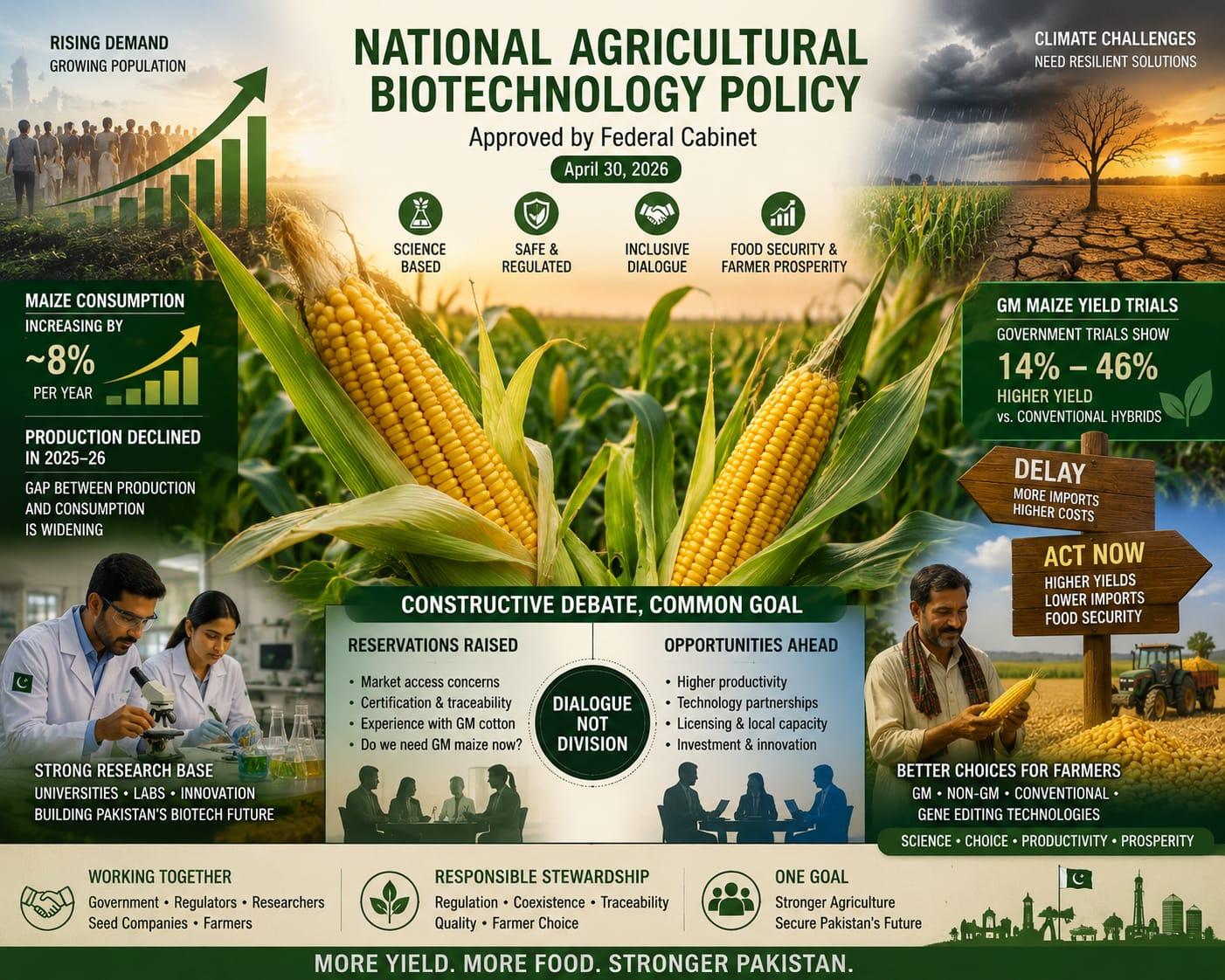
With Pakistan facing rising food demand, increasing maize consumption, climate-related challenges and concerns over future agricultural productivity, stakeholders in the country’s seed and agriculture sectors have called for timely implementation of the National Agricultural Biotechnology Policy, while Seed Association of Pakistan (SAP) and other representatives of the local seed industry have raised reservations about the adoption of genetically modified (GM) maize.
The Federal Cabinet approved the National Agricultural Biotechnology Policy on April 30, 2026, following extensive consultations. Stakeholders supporting agricultural biotechnology say that, after the policy’s approval, the focus should now shift from prolonged debate to implementation, scientific evaluation and constructive engagement among all concerned parties.
Agricultural experts and technology proponents argue that Pakistan should assess modern agricultural technologies on the basis of scientific evidence, field trials, productivity gains and their potential economic benefits for farmers rather than treating the debate simply as a choice between GM and non-GM agriculture.
Maize has become increasingly important to Pakistan’s agriculture and food economy, not only as a food crop but also as a major raw material for the poultry, livestock and feed industries.
Pakistan’s population is growing at around two percent annually, while maize grain consumption is estimated to be increasing by around eight percent a year. At the same time, maize production recorded a decline during 2025-26, raising concerns that the gap between domestic production and consumption could widen in the coming years.
Agricultural experts warn that if production fails to keep pace with growing demand from the population, poultry and livestock sectors, Pakistan may have to rely increasingly on imported maize, putting additional pressure on the country’s import bill.
They argue that increasing yield per acre is therefore becoming essential, and modern technologies can play an important role in protecting crops from pests and other production risks while improving productivity.
According to figures cited by industry representatives, government yield trials involving GM maize hybrids recorded productivity gains ranging from 14 percent to 46 percent compared with conventional hybrids. Supporters of the technology say such results warrant serious consideration rather than delaying implementation of the policy.

Rashid Ahmad, who is the Executive Director of CropLife Pakistan Association (CLPA), has maintained that actually, there is no competition between local seed companies and multinational technology developers, but Pakistan’s national seed industry should align itself with the global direction toward agricultural innovation and support implementation of the National Agricultural Biotechnology Policy.
“It is inconsistent to participate in international seed forums that support innovation while opposing Pakistan’s own national policy for agricultural biotechnology,” he said. “Pakistan must not be held back when other countries are moving ahead under science-based regulatory systems.”
According to Ahmad, multinational companies entering the Pakistani market would not necessarily eliminate local businesses. Instead, technology partnerships, licensing arrangements, foreign investment and increased competition could create new opportunities for national seed companies.
He said CLPA member companies were willing to engage with national seed companies to explore technology licensing and partnership models that would allow local businesses to access approved biotechnology traits.
Under such arrangements, local seed companies could incorporate approved traits into locally relevant hybrids, commercialize them after regulatory approval and continue developing their own seed portfolios and relationships with farmers.
Industry representatives point to the Philippines and Vietnam as examples of how biotechnology and local seed businesses can coexist.
In markets where approved GM maize traits have been made available through licensing arrangements, local and regional seed companies have been able to develop and commercialize locally relevant hybrids following regulatory approvals.
Supporters argue that these examples demonstrate that biotechnology does not necessarily have to displace national seed companies. With responsible stewardship, clear regulations and technology licensing, local businesses can become participants in the biotechnology value chain.

On the other side of the debate, former chairman of the Seed Association of Pakistan (SAP) Chaudhry Asif Ali has expressed reservations about the introduction of GM maize and questioned whether Pakistan needs the technology at this stage.
According to him, GMO technology faces restrictions or regulatory concerns in various countries and regions, including parts of the
Asia-Pacific region and India. He also argued that the United States is focusing on bringing improved genetics rather than relying exclusively on GMO technology.
However, biotechnology proponents point out that the United States does not have a general ban on GM crops. Rather, biotech crops are regulated through established regulatory frameworks, and GM technology is widely used in American agriculture.
The former chairman also questioned the need for GM maize if Pakistan is already competing with other countries in terms of yield per acre.
He cited the Philippines as an example, arguing that despite its adoption of GM maize, its yield per acre has not surpassed the levels achieved by India through non-GM approaches. Biotechnology experts, however, caution against making direct country-to-country comparisons solely on the basis of whether a crop is GM or non-GM.
Yield depends on several factors, including genetics, climate, irrigation, soil quality, fertilizer use, pest pressure, farm management and the quality of seed.
They argue that the appropriate test for Pakistan should therefore be the results of local, independently evaluated field trials, rather than comparisons based simply on the GM or non-GM label.
The former Seed Association chairman also raised concerns that the use of GM crops could increase certification, traceability and segregation requirements for accessing certain international markets.
Biotechnology proponents acknowledge that different markets may have different requirements for GM and non-GM products. However, they argue that such challenges can be managed through a transparent regulatory and stewardship framework.
Proper isolation protocols, traceability, quality control and coexistence measures can allow GM and non-GM value chains to operate alongside each other while protecting farmer choice and maintaining seed purity.
Chaudhry Asif Ali also referred to Pakistan’s experience with GM cotton, arguing that the adoption of GMO technology had not produced the expected increase in yield per acre and that cotton productivity subsequently declined during certain periods.
Biotechnology supporters respond that Pakistan’s cotton crisis cannot be attributed solely to GM technology. Cotton productivity has been affected by a combination of factors, including seed quality, pest pressure, climate change, water availability, farming practices and weaknesses in the seed system.
They argue that the lesson from cotton should be to strengthen the complete technology and seed-delivery system rather than reject biotechnology altogether.
According to this view, improved genetics, quality seed, responsible stewardship, effective pest management and sound agronomic practices must work together if farmers are to obtain the maximum benefit from any new technology.
Pakistan already has a growing research base in agricultural biotechnology, with numerous universities, research institutions and laboratories working in the field.
Industry representatives believe the introduction of advanced biotechnology could create opportunities not only for multinational companies but also for Pakistani researchers, universities and local seed companies.
They argue that multinational companies bringing foreign investment, research and advanced technologies into Pakistan can potentially contribute to knowledge transfer, research partnerships and capacity building for local institutions.
Rather than viewing international technology developers solely as competitors, they say Pakistan should explore partnerships that allow domestic institutions and businesses to benefit from global research and technological advances.
Supporters of biotechnology also point to international and regional seed organizations, including the International Seed Federation and the Asia & Pacific Seed Association (APSA), as platforms that promote plant-breeding innovation, quality seed systems, regulatory advocacy and access to improved agricultural technologies.
Both multinational and national seed companies participate in such international and regional platforms.
Industry representatives stress, however, that membership in these organizations does not mean that companies or countries are forced to adopt any particular technology. Rather, they argue that members should support the principles of science-based regulation, innovation and responsible technology development promoted by these organizations.
CLPA has invited National seed associations (SAP) and local seed companies to engage in dialogue on technology licensing, stewardship, coexistence and commercialization opportunities.
Rashid Ahmad said the government should mediate between multinational technology providers and national seed companies and provide a platform where genuine concerns can be addressed through evidence-based discussions.
He said local seed companies should not view the arrival of multinational companies as an automatic threat to their businesses.
According to him, increased investment and access to advanced technologies can instead create new business opportunities, encourage local companies to improve their research and breeding capabilities and strengthen the overall competitiveness of Pakistan’s seed industry.
He also expressed concern that some opposition to biotechnology may be influenced by the protection of existing business interests rather than broader national agricultural priorities.
Supporters of the National Agricultural Biotechnology Policy argue that the policy was approved against the backdrop of Pakistan’s growing food-security challenges and the increasing impact of climate change on agriculture.
They say the country cannot afford to ignore technologies that could help farmers increase productivity, protect crops and improve resilience.
The debate is not limited to maize. Supporters believe biotechnology and advanced breeding technologies could potentially benefit several crops by improving resistance to pests, diseases, environmental stresses and other factors that reduce yields.
For Pakistan, they argue, the objective should not be to replace conventional breeding or non-GM technologies but to expand the range of tools available to researchers, seed companies and farmers.
The central question, according to biotechnology proponents, is not whether Pakistan should choose multinational companies over local seed businesses, or GM over non-GM agriculture.
The real question is whether Pakistan will build a competitive, innovation-driven agricultural sector capable of meeting rising food demand and adapting to climate change or continue delaying technologies that have the potential to improve productivity and farmer incomes.
The government’s approval of the National Agricultural Biotechnology Policy has already established the policy direction. Stakeholders now say the next step should be transparent implementation, rigorous scientific evaluation and dialogue among national seed companies, technology developers, researchers, regulators and farmers.
For a country where maize demand is rising rapidly and future production is under pressure, supporters argue that delaying access to productivity-enhancing technologies could eventually prove more costly than carefully regulating and responsibly adopting them.
They maintain that farmers should ultimately be given access to GM, non-GM, conventional breeding and emerging gene-editing technologies, provided each is assessed through transparent, science-based regulatory procedures.
The objective, they say, should be simple: give Pakistani farmers better choices, increase agricultural productivity, strengthen the national seed industry and protect Pakistan’s long-term food security.
-- The writer is a staff member of GNN and writes on burning issues and latest advancements in agriculture, aviation and governance

Bahrain praises professionalism of Pakistan Armed Forces
- 5 hours ago

The Cornell case, explained
- 10 hours ago

Pakistan, IMF reach staff-level agreement for $1.2bn tranche
- 10 hours ago

OpenAI PR tells journalist to ‘move on’ while asking Sam Altman about a ChatGPT user’s suicide
- 21 hours ago

Bollywood actor Nana Patekar passes away at 75
- 11 hours ago
Pakistan on frontlines of climate chaos despite minimal emissions: UN chief
- 7 hours ago
The real reason the Russia plague case should scare you
- 19 hours ago

Trump’s “Most EXCLUSIVE DINNER IN THE WORLD”
- 19 hours ago

I can’t use Apple’s new Screen Time on my daughter’s iPhone because my son won’t update his MacBook
- 21 hours ago

The two athletes in every horse race
- 19 hours ago
Pakistan, Bahrain to enhance cooperation in diverse sectors
- 7 hours ago

Will Trump’s diesel order do anything?
- 10 hours ago