Are we on the precipice of a white Christian nationalist takeover? The author and religion scholar Robert P. Jones sure feels like we’re close. “This is our 1933,” he writes in his new book, referencing the year that Weimar Germany fell to a Nazi takeover. P…

Published a month ago on Sep 8th 2026, 4:00 pm
By Web Desk
Are we on the precipice of a white Christian nationalist takeover?
The author and religion scholar Robert P. Jones sure feels like we’re close. “This is our 1933,” he writes in his new book, referencing the year that Weimar Germany fell to a Nazi takeover.
Panicked allusions to Nazi Germany have been a common occurrence in the Trump years. But Jones, who has studied religion for decades and grew up Southern Baptist, has a very specific perspective on why those references are warranted now, particularly because of the role Christians played then — and it all worries him.
It was in 1933, Jones writes, that the German Lutheran pastor Martin Niemöller began resisting Nazi rule. He was arrested four years later and imprisoned at the Dachau concentration camp until 1945. Revisiting Dachau after World War II, Niemöller remembered 1933 as not just the year the camp opened, nor a reminder of a time when he was still a free man, but also a marker of how much time he had wasted in the preceding years supporting the Nazis. From their rise in the 1920s until that moment, he’d been supportive of much of the Nazis’ movement, voting for them in three different elections. After his release, every day of that time felt like a missed opportunity to do something to avert a tragedy.
Jones doesn’t make this historical parallel lightly. In his new book, Backslide: Reclaiming a Faith and a Nation After the Christian Turn Against Democracy, he spends a significant amount of time building the case that the actions of the second Trump administration, combined with rock-solid support from white Christian evangelicals, are resulting in escalating religious authoritarianism, pointing to evangelical support for mass deportations earlier this year and Christian nationalist rhetoric by members of the administration, such as Defense Secretary Pete Hegseth. “We are now living in a democratically back-slidden nation, abetted by an apostate white Christianity,” he writes.
But his book isn’t just a panicked observation; it’s a call to action. Like Niemöller, he argues, religious people who’ve sat out or passively supported MAGA can still effect change. And churches are just as important to stopping a slide into religiously backed authoritarianism as many were in abetting its rise.
So what should Christians who don’t buy into this vision of their faith do to resist it?
Jones is the president and founder of the Public Religion Research Institute, the leading research and polling think tank on politics and religion, and a scholar of religion — spending his career analyzing and writing books on the relationship between race, white supremacy, and faith in America. I decided to chat with him to figure out what the road map for Christian resistance to Christian nationalism might look like. Our conversation has been edited for length and clarity.
Why are you taking on this project now?
If you look back at the three previous books I’ve written in the last decade, they have been responding in various ways to the rise of Christian nationalism that we’ve seen in the country and the threat that that poses. This book is motivated by a sense of urgency.
I’m also trying to turn the corner in this book by saying, For those of us who care about the integrity of Christianity and the future of democracy, the real question is what are we going to do in this moment?
Throughout the book, you argue that there is very little daylight between what the administration is doing and what white Christian evangelicals will support. I think immigration policy comes to mind: that it’s hard to propose draconian enforcement policies that these Christians won’t tolerate. Do you really expect people to change?
So the line you’re thinking about — because I remember writing this line — it was, “In the Trump era, white evangelical attitudes about undocumented immigrants are so extreme that it seems virtually impossible to construct a policy that is too brutal for them to support.”
I go through the options [offered in PRRI polling]: Do you support putting things like razor wire and barricades in a river that might make people drown? Yep, we’re good with that. Do you put people in internment camps? Yep, we’re good with that. And so I do think it should be shocking to hear those kinds of responses, again, from people who say they follow a Bible that talks more about caring for the widow or the orphan and has a lot to say about immigrants and the stranger who resides among you and being kind to them, not oppressing them.
I even say at the beginning of the book, I’m not writing for the people who have completely given themselves over to this MAGA worldview. And the evidence shows that it is the vast majority of white evangelicals that have done that. But among white Catholics, among white mainline Protestants, it’s less of a complete acquiescence to that seductive political worldview. That’s who I’m writing to.
I’m a pragmatist on this point. At the end of the book, I talk about the need for division, and that we have to realize that there are going to be some people who are so wedded to this kind of power and violence that they’re beyond persuasion. The only solution is to out-organize and resist that movement and to stand up something else in its wake.
We’re starting to see some of that as well. White evangelicals only make up 13 percent of the country. And even though almost 85 percent of them are all in on the MAGA movement, that’s nowhere near a majority of the country.
And even if you take everyone who supports a Christian nationalist worldview, it’s only about three in 10 Americans. Now that’s a lot, and it’s a majority of Republicans and it’s two-thirds of white evangelicals in that camp. But it does mean that the country as a whole rejects that worldview by a margin of 2-to-1.
The biggest challenge has been apathy among many white Christians who have watched this extremism take hold, have watched it grow, and have really been uncomfortable speaking out and saying, Wait, wait, wait, that’s not how I understand Christianity. That’s not how I understand the Bible or the teachings of Jesus. And so I think this book is in some ways aimed at that group and saying, Yeah, it’s kind of now or never. If you want a different version of Christianity to exist in this country, it’s time to stand one up and make it a very publicly visible thing.
So where does that leave us in terms of resisting and out-organizing? What is the playbook for beating back this takeover?
I’m pretty convinced that if we’re talking about persuading the folks that have been all in for Trump for a decade now, for three consecutive elections, that’s a fool’s errand.
But I do think there’s a bunch of folks in the middle that aren’t that group. The white mainline Protestant world is much more divided. The white Catholic world is much more divided. The Latino evangelical world is much more divided than the white evangelical world. And so there are other groups of Christians that I think are still debating this out. And I think those are the places where I think there’s fertile ground for a conversation to be had. And I also think there is a great mass of Christians that have been very deeply but quietly disturbed at the way that Christianity has been portrayed and hijacked, but haven’t really found their voice or their feet in putting out a different version.
One thing to say here too is that we have long had Christian voices and, to talk Democratic politics for a minute, in the Democratic Party, they’ve just mostly not been white: the late Rep. John Lewis, Democratic Rep. Jim Clyburn from South Carolina, Sen. Raphael Warnock, who have been very eloquent about talking about their own faith. Warnock is himself a pastor at Martin Luther King’s old church, so very prominent.
But I think what we’ve had less of is people who come out of the white Christian denominations who have been willing to speak from their faith perspective in that way. And I think it’s why Texas Senate candidate James Talarico’s gotten so much attention because he doesn’t fit the mold in many ways. But we are seeing half a dozen other folks running up and down and from a lot of Midwestern states, which is interesting.
And partially that’s because in those Midwestern states, the white evangelical group is typically smaller than the white mainline — in Iowa, in Michigan, and those kinds of upper Midwest states. And so I think we’re seeing more people coming out of that mainline Protestant, Presbyterian, Lutheran world that are representing that. And in Minneapolis, we saw that as well [the active organizing of Lutheran and other mainline Protestant communities to protest ICE, aid immigrant communities, and monitor ICE agent movements].
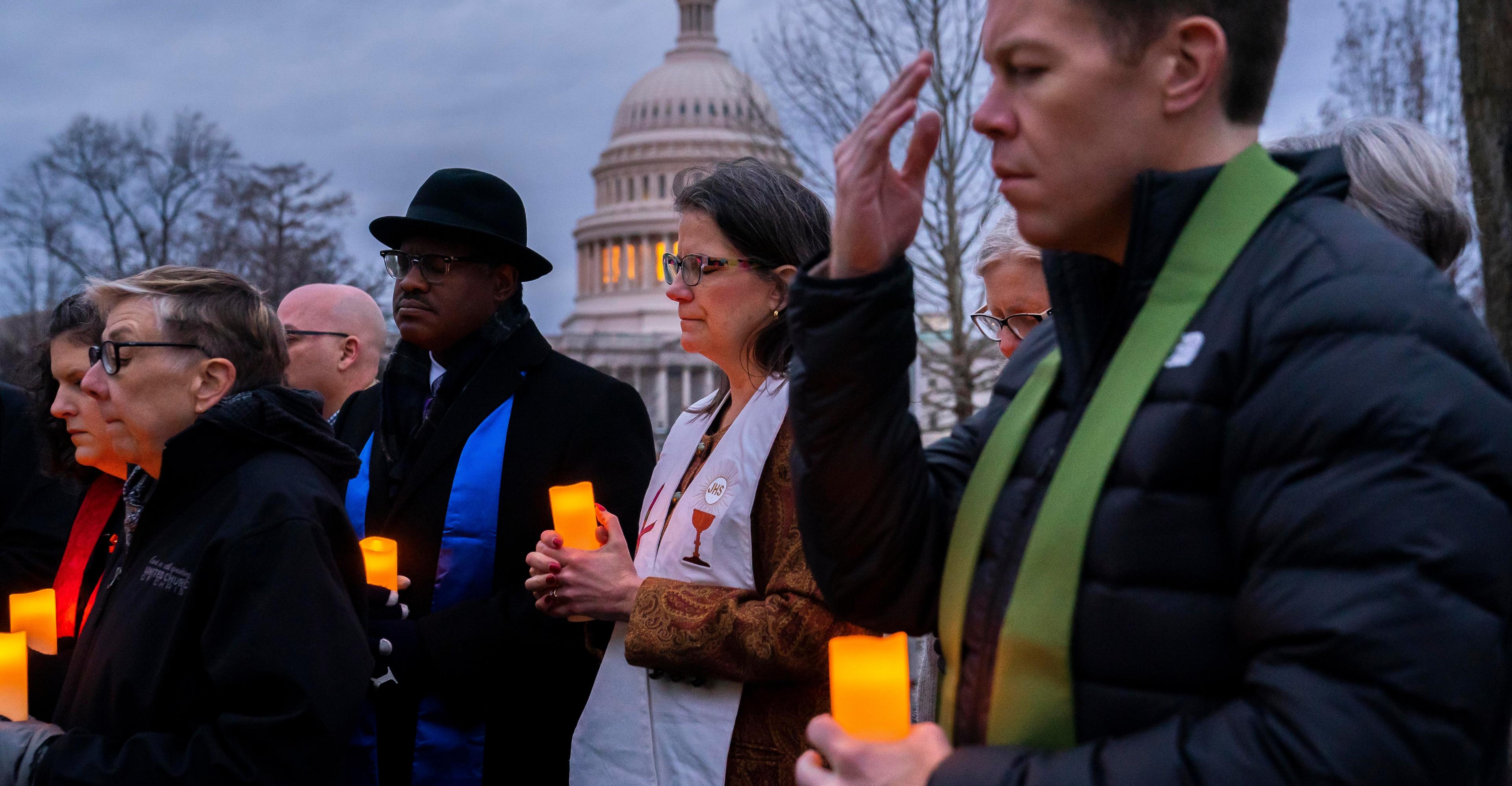
I’m also thinking in Texas, there was just a story about a Catholic bishop and parishes in a community outside of El Paso that looks like they’ve successfully stopped ICE from building a very large detention center. And Pope Leo has been speaking out about this as well. So I think there are these signs that this other voice of Christianity is emerging, particularly out of alternative white Christian spaces. And I think that’s super, super important.
What does that mean for the average person reading this? What should they be doing?
In the last three years, I’ve probably been invited to well over a hundred mostly predominantly white Christian churches who are asking the question: What can we do? And how do we resist this in our communities? How do we stand up and be a witness to a different kind of Christianity that centers love rather than fear and inclusion rather than exclusion?
And there’s now either five or six major denominations that have either already adopted or are in the process of adopting official statements against Christian nationalism, in their denominations, which are ways of signaling to all the local pastors and all the local churches in their denomination that we see this as a danger and trying to help them draw some bright lines that are helpful at the local level.
So there is movement. And I do think that many of the people that have left Christianity are realizing that there are some alternatives out there.
One thing we political journalists wrestle with is making sure we’re not talking down to voters or readers, or asserting feelings or attitudes about people to them. Did you wrestle with that, in making the case that a segment of white evangelical Americans are racist or bigoted?
Of course, and this is where I have standing as an author. I bring an insider and outsider perspective to this topic, having been raised inside the Southern Baptist world in the Deep South. I have my undergraduate degrees from a Baptist college. I have a master’s degree from a Baptist seminary. So these are waters that I have drunk fairly deeply from the inside. And since I have the sociological data, I have an external perspective on it as well. What the book does is work as a back-and-forth between these two lenses.
And it actually gives me some empathy because, if for no other reason, these are my people. These are my friends, these are my relatives, these are my family. So I’m not looking down my nose or a foreigner wagging their finger in disgust. That’s not who I am.
I’m not afraid to make some moral judgments in the book. I mean, that’s a deeply distorted and destructive story that we’ve inherited in the country that the US was intended to be of, by, and for Christians of European descent. So I’m partially trying to show how it’s destructive and how, for example, these kinds of beliefs connect to things like racism against African Americans and anti-immigrant attitudes, antisemitic attitudes, a whole denial of systemic racism and history in the country. I think if we’re going to have a healthy country and frankly a healthy faith, we really are going to have to reckon with these things.
So should we be promoting a return to these churches and denominations as an effort to revive Christianity and fight back against the encroachment of Christian nationalism?
I should be clear that this book is really not defending Christianity. I fully understand why people have left the church in such large numbers over the last two decades. All I can do is nod my head when people narrate the reasons why they’ve left. I think what I can say for myself is that I’ve found that sometimes, even despite myself, I still care very deeply about the faith of Christianity in this country.
This book is speaking into that. It’s not a proselytizing book. I’m not arguing that anybody who’s left should come back.
But the point is to say that we have this threat of the faith being hijacked for this Christian nationalist purpose. And for those of us who do still feel connected to this faith, it is really a critical time to reclaim it and to put forward a version of it that I would say is more consistent with a religion that emphasizes love and care for the vulnerable, and that is fully compatible with a pluralistic democracy. It’s a really critical time in our country’s history for that faith to emerge as it can.
That faith is actually quite compatible and would find a common cause even with the people who have left for all those reasons. So I think that’s the thing. It’s not a faith that sets itself against those who’ve left, or, if anything, is fairly sympathetic to the reasons those people have left.

Buying Apple’s wall-mounted HomeView? The mount costs extra
- a day ago
Florida’s uniquely horrifying death penalty system
- a day ago

Jodar apologises for swearing at ball kid in Shanghai
- 2 days ago
The Ocarina of Time remake feels remarkably modern — and surprisingly terrifying
- a day ago

Here are all the new HomePod Mini 2 colors
- a day ago
Trump’s revenge campaign comes for Ilhan Omar
- a day ago

Pakistan warns India against any misadventure: FO
- 2 days ago

Character.AI files for bankruptcy
- a day ago

West Bank settlers brutally attack a Washington Post journalist
- 7 hours ago
Cold weather and high prices could flip the Senate
- a day ago

Hands-on with the Apple Home Collection
- a day ago
Will November stop Trump’s agenda?
- a day ago
You May Like


Trending