The bench headed by Chief Justice of Pakistan Umar Ata Bandial will start hearing of the three petitions at 11: 30 on Thursday.

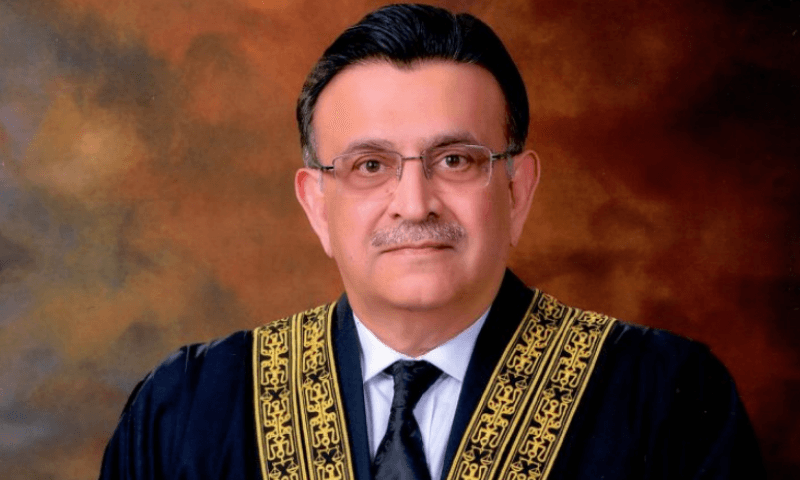
Islamabad: The Supreme Court of Pakistan will hear three petitions challenging a bill that limits the powers of the Chief Justice of Pakistan (CJP) on Thursday. The eight-member bench, consisting of CJP Umar Ata Bandial, Justice Ijazul Ahsan, Justice Munib Akhtar, Justice Sayyad Mazahar Ali Akbar Naqvi, Justice Muhammad Ali Mazhar, Justice Ayesha Malik, Justice Syed Hasan Azhar Rizvi, and Justice Shahid Waheed, will convene at 11:30 am, according to the roster issued on Wednesday.
Advocate Muhammad Shafay Munir, Raja Amer Khan, Chaudhry Ghulam Hussain, and others have filed the petitions under Article 184(3) of the Constitution. This article empowers the Supreme Court to assume jurisdiction in matters involving a question of "public importance" related to the "enforcement of any of the fundamental rights" of Pakistan's citizens.
Advocate Munir stated in his petition that the plea had been submitted to safeguard and secure the Constitution and independence of the judiciary. The petitioner argued that they believed in the supremacy of the Constitution, the rule of law, and the independence of the judiciary, and had consistently strived to protect these principles.
The federal government, through the secretaries of law, Senate, and National Assembly, are named as respondents in the petitions. The bill in question, titled the Supreme Court (Practice and Procedure) Bill 2023, aims to strip the office of the CJP of its powers to take suo motu notice in an individual capacity. It was initially passed by both houses of parliament and sent to the president for his assent. However, the president sent it back, stating that the proposed law exceeded "the competence of parliament."
On Monday, the bill was passed by a joint sitting of parliament with some amendments, amid protests from PTI lawmakers. Notably absent from the bench are Justices Qazi Faez Isa and Justice Aminuddin Khan, who had earlier ruled that the CJP did not have the authority to form special benches or select their members and ordered the postponement of all suo motu cases. The order was subsequently rescinded by a six-member larger bench. Justice Isa later stated in a judicial note that the bench did not "constitute a constitutional court."
The Supreme Court hearing on Thursday will be closely watched by legal experts and political analysts, as the outcome could have far-reaching implications for the balance of power in Pakistan's judiciary.

What Christina Applegate’s misdiagnosis reveals about MS
- 19 hours ago

How the biggest renewable energy project in US history finally got built
- 19 hours ago

Field Marshal Munir vows total defeat of terrorists with public support
- 11 hours ago

GM promises smarter cars, faster updates, and autonomous dry-cleaning runs
- 21 hours ago

The Cornell rape case has surfaced a hidden divide among progressives
- 19 hours ago

10 terrorists, including one female, killed in Gwadar: ISPR
- 8 hours ago

US military bans BYD vehicles from strategic air base in Japan
- 10 hours ago

This Democrat’s accountability plan has Trump fuming
- 19 hours ago

PM Shehbaz sets illustrative wheat price at Rs4,500 per 40kg for 2027
- 4 hours ago

Conversational Gemini navigation comes to Apple CarPlay
- 21 hours ago

Russia released a US prisoner. What did they get out of it?
- 19 hours ago

FinMin Aurangzeb, WB discuss Pakistan's economic reform agenda
- 5 hours ago