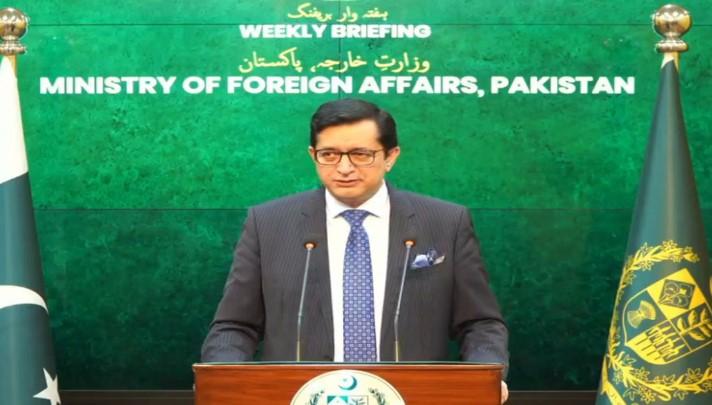
The book titled "Afghanistan-Pakistan Shared Waters: State of the Basins" was presented at a ceremony in the federal capital, attended by foreign diplomats, government officials, and development sector representatives.

Islamabad: A book covering water resources management on transboundary river basins shared between Afghanistan and Pakistan was launched on Tuesday.
The book titled "Afghanistan-Pakistan Shared Waters: State of the Basins" was presented at a ceremony in the federal capital, attended by foreign diplomats, government officials, and development sector representatives.
The publication received funding from USAID-Pakistan Mission through their Water Management for Enhanced Productivity (WMfEP) program, being implemented by the International Water Management Institute (IWMI). The program's objective is to enhance productivity by improving water management practices.
It is worth noting that this book is the first to be published after the Taliban regained power in Afghanistan in August 2021. The book is the result of a long and, at times, challenging co-production journey. This process has never been attempted before in the shared river basins of Kabul, Kurram, and Gomal. Despite the difficulties encountered, the process brought together a diverse group of experts from both Afghanistan and Pakistan in a collaborative initiative.
"I am really honored to be a part of this book launch. I'm glad that USAID has a role in making this book happen. This publication also exemplifies the qualities of integration and partnership that are so important to our shared enterprise of building climate resilience in Pakistan and in this region. So, as has already been pointed out, this is a joint research project between Pakistani scholars, afghan scholars, and international scholars. It also points us in the direction of cross-border cooperation on climate between Pakistan and Afghanistan. I would also say that we are at the beginning stages of this enterprise. And if it's one thing about international relations, diplomacy, when you have sensitive relationships, a good place to start is through joint research, cooperative research on issues that are of concern to both countries. I think this project is an important step towards what we are all striving for, water security for everyone in this region. So I wish to thank IWMI for this valuable initiative," said Mr. Stephen Berlinguette, Director, Climate Sustainable Growth Office, USAID Pakistan.
Dr. Azeem Ali Shah, lead author and editor of the book said that transboundary water management is a difficult aspect of water governance and improved water resource management, not only in Pakistan but globally. The interests of riparian nations in hydraulic infrastructure development on shared rivers endanger the socio-economic well-being of others, especially those downstream. This leads to a deficit in trust and conflicts among riparian nations.
"To address this issue, nations need to come together and develop plans and actions for judicious water resource development and operation. These plans should benefit all riparian countries, especially those downstream. A win-win approach needs to be explored, negotiated, and implemented to attain shared benefits," he added.
Some of the negotiations between Pakistan and Afghanistan particularly on the Kabul River have not yielded concrete results in past primarily due to a lack of information and hydro-meteorological data across the border. The same is the case with the other two river basins.
He said that the book would help them to understand these basins in a better way, adding that this would also provide us with a basis to engage in meaningful discussion with our neighbor.
Dr Mark Smith, Director General of the International Water Management Institute (IWMI), emphasized the importance of international cooperation in managing transboundary water resources, particularly in regions where neighboring countries rely on shared rivers for their livelihoods and economic development.
He pointed out that 90% of Afghanistan's surface water resources are shared with downstream neighboring countries, including Pakistan, Iran, Tajikistan, and Turkmenistan.
The DG said Afghanistan and Pakistan share nine rivers with a combined population of over 43 million residing in these basins. Yet, there is currently no water management agreement or cooperation between Afghanistan and Pakistan.
“This is the first book to cover major aspects of water resources management and development on the major transboundary river basins shared between Afghanistan and Pakistan, together in one volume,” he remarked.
“As stated in the book, it is the author’s sincere hope that this book reaffirms to both countries that cooperation remains an option.”

Hands-on with the Apple Home Collection
- a day ago

Florida’s uniquely horrifying death penalty system
- 2 days ago

Jodar apologises for swearing at ball kid in Shanghai
- 2 days ago

Will November stop Trump’s agenda?
- 2 days ago

West Bank settlers brutally attack a Washington Post journalist
- 13 hours ago

Character.AI files for bankruptcy
- 2 days ago
FIA offloads 2 passengers at Lahore airport over fake documents, tampered study visa
- 4 hours ago

Cold weather and high prices could flip the Senate
- 2 days ago

Trump’s revenge campaign comes for Ilhan Omar
- 2 days ago

The Ocarina of Time remake feels remarkably modern — and surprisingly terrifying
- 2 days ago

Buying Apple’s wall-mounted HomeView? The mount costs extra
- a day ago

Here are all the new HomePod Mini 2 colors
- 2 days ago