The Indian premier’s ruling Bharatiya Janata Party (BJP) is expected to win the election convincingly

New Delhi (AFP): Hindu nationalist Prime Minister Narendra Modi cast his ballot Tuesday in India’s ongoing general election after giving several inflammatory campaign speeches accused of targeting minority Muslims.
Turnout so far has dropped significantly compared with the last national poll in 2019, with analysts blaming widespread expectations that Modi will easily win a third term and hotter-than-average temperatures heading into the summer.
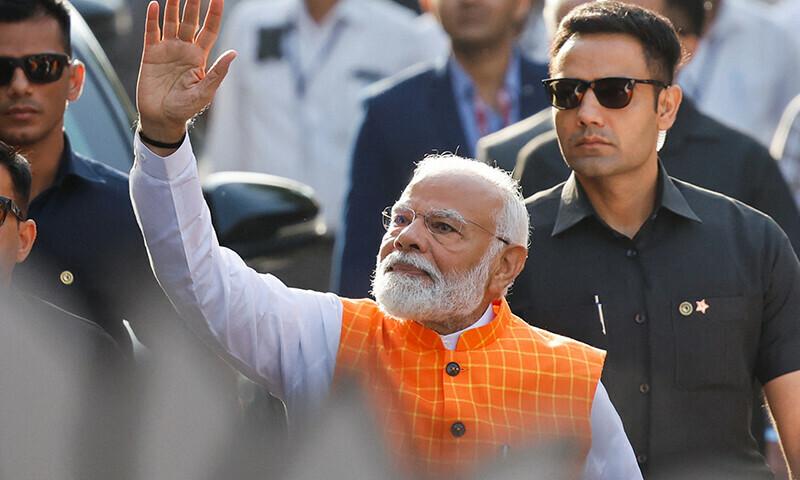
Modi walked out of a polling booth early morning in the city of Ahmedabad while holding up a finger marked with indelible ink, flanked by security personnel and cheered by supporters.
India’s Prime Minister Narendra Modi waves on the day he votes during the third phase of the general election, in Ahmedabad, India, May 7, 2024. — Reuters
“In the grand ritual of democracy, everyone contributing their share deserves congratulations,” Modi told reporters. “Once again, I tell Indians… to come in huge numbers to vote and celebrate the festival of democracy.”
The Indian premier’s ruling Bharatiya Janata Party (BJP) is expected to win the election convincingly, but since the vote began on April 19, Modi has stepped up his rhetoric on India’s main religious divide in a bid to rally voters.
He has used public speeches to refer to Muslims as “infiltrators” and “those who have more children”, prompting condemnation from opposition politicians, who have complained to election authorities. Modi has also accused Congress — the main party in the disparate opposition alliance competing against him — of planning to reallocate the nation’s wealth to Muslim households.
“This is the first time in a long time that he is so direct,” said Hartosh Singh Bal, executive editor at news magazine The Caravan. “I haven’t seen him be this directly bigoted, usually he alludes to bigotry,” he added.
“The comments on wealth redistribution are targeting something from the Congress manifesto that just does not exist and that is frankly quite unfortunate.”
‘Anyone with a beard’
Modi remains widely popular a decade after coming to power, in large part due to his government’s positioning the nation’s majority faith at the centre of its politics, despite India’s officially secular constitution.
In January, the prime minister presided over the inauguration of a grand temple to the deity Ram, built on the site of a centuries-old mosque razed by Hindu zealots decades earlier.
Construction of the temple fulfilled a long-standing demand of Hindu activists and was widely celebrated across India, with extensive television coverage and street parties. Modi’s brand of Hindu-nationalist politics has made India’s 220-million-plus Muslim population increasingly anxious about their future in the country.
“The government is blatantly doing sectarian politics,” Munna Usman, a Muslim travel agency owner in the city of Agra, told AFP. Usman, 48, said the result was that every Hindu in India was now “suspicious of anyone with a beard”.
The election commission has not sanctioned Modi for his remarks despite its code of conduct prohibiting campaigning on “communal feelings” such as religion.
Hot weather
India’s election is conducted in seven phases over six weeks to ease the immense logistical burden of staging the democratic exercise in the world’s most populous country. Much of southern Asia was hit by a heatwave last week that saw several constituencies vote in searing temperatures.
In the city of Mathura, not far from the Taj Mahal, temperatures crossed 41 degrees Celsius on polling day, and election commission figures showed turnout dropping nearly nine points to 52 percent from five years earlier.
A turnout data analysis published by The Hindu newspaper concluded it was too early to determine whether hot weather was impacting voter participation.
But India’s weather bureau has forecast more hot spells to come in May and the election commission formed a taskforce last month to review the impact of heat and humidity before each round of voting.
Modi told reporters after leaving the polling station that he encouraged voters to drink “as much water as possible”. “The more water you drink, the better your health and energy levels are maintained,” he said.
High temperatures were forecast for several locations voting on Tuesday including the states of Madhya Pradesh and Bihar. Years of scientific research have found climate change is causing heatwaves to become longer, more frequent and more intense.
More than 968 million people are eligible to vote in the Indian election, with the final round of polling on June 1 and results expected three days later.
Iran will not allow enriched nuclear material to leave the country, security chief says
- a day ago

Epic Games Launcher is coming to SteamOS
- 16 hours ago

Who will take care of us when we get old?
- a day ago

The UV-tracking Gem made me rethink how sunlight affects my health, not just my appearance
- 16 hours ago

NYT Cooking’s AI assistant saved my weeknight chicken, but almost ruined my cake
- 16 hours ago

Soul Glo’s Diaspora Problems is a hardcore record like no other
- 16 hours ago
Pakistan calls for dialogue, implementation of peace deal in South Sudan
- a day ago

Are you abandoning the fight if you move from a red state to a blue one?
- a day ago
Hegseth’s “maximum lethality” comes back to haunt him
- 14 hours ago
Trump’s 60 Minutes interview touched on AI safety, threat to arrest an AI exec
- a day ago

Did the midterms kill MAGA?
- 14 hours ago

Instagram’s AI age detection is expanding globally
- a day ago