India’s chief of defence staff said that India suffered initial losses in air

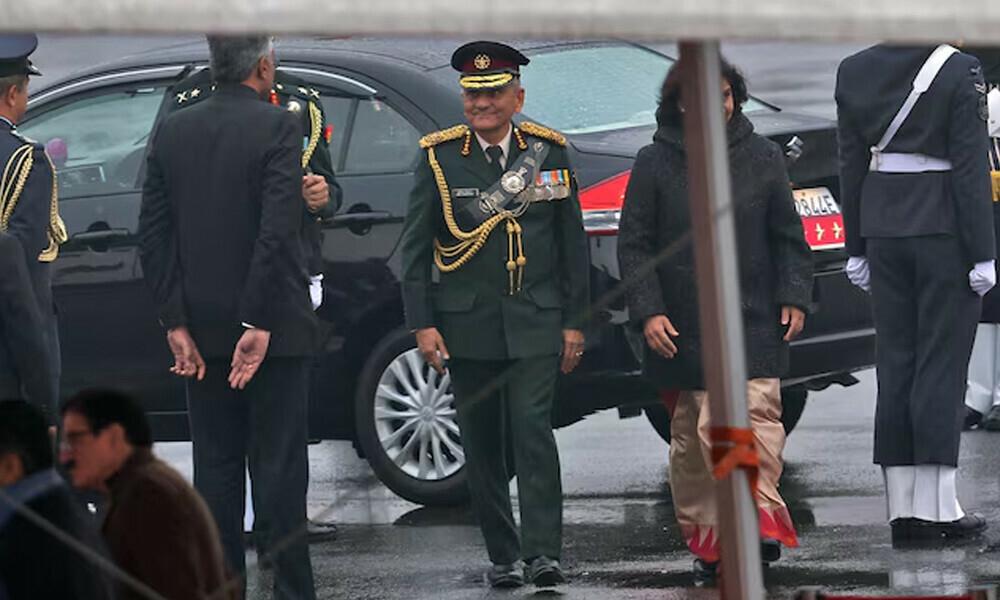
Singapore: India switched tactics after suffering losses in the air on the first day of conflict with Pakistan earlier this month and established a decisive advantage before the neighbours announced a ceasefire three days later, India’s highest-ranking general said on Saturday.
The heaviest fighting in decades between Pakistan and India was sparked by an April 22 attack in Indian Illegally Occupied Jammu and Kashmir (IIOJK) that killed 26 people, most of them tourists. New Delhi blamed the incident on ‘terrorists’ backed by Pakistan, a charge denied by Islamabad.
On May 7, Indian jets bombed what New Delhi claimed ‘terrorist infrastructure’ sites across the border. Pakistan has said it downed six Indian planes, including at least three Rafale fighters, in the initial clashes.
The ceasefire was announced on May 10 after bitter fighting in which both sides used fighter jets, missiles, drones, and artillery.
General Anil Chauhan, India’s chief of defence staff, said in an interview that India suffered initial losses in the air, but declined to give details.
“What was important is, why did these losses occur, and what we’ll do after that,” he told Reuters on the sidelines of the Shangri-La Dialogue security forum in Singapore, referring to the Pakistani claim of downing jets.
“So, we rectified tactics and then went back on the 7th, 8th, and 10th in large numbers to hit air bases deep inside Pakistan, penetrated all their air defences with impunity, carried out precision strikes”.
The Indian air force “flew all types of aircraft with all types of ordinances on the 10th,” he said.
India has previously said its missiles and drones struck at least eight Pakistani air bases across the country that day, including one near the capital, Islamabad.
The Pakistan military says that India did not fly its fighter jets again in the conflict after suffering losses on May 7.
India’s director general of air operations, Air Marshal AK Bharti, had told a press conference earlier in the month that “losses are a part of combat” and that India had downed some Pakistani jets.
Islamabad has denied it suffered any losses of planes but has acknowledged its air bases suffered some hits although losses were minimal.
No nuclear worries
Some of the attacks were on bases near Pakistan’s nuclear facilities, but they themselves were not targeted, media reports have said.
“Most of the strikes were delivered with pinpoint accuracy, some even to a metre, to whatever was our selected mean point of impact,” Chauhan claimed.
Chauhan, and Pakistan’s chairman of the joint chiefs of staff, General Sahir Shamshad Mirza, have both said there was no danger at any time during the conflict that nuclear weapons were considered.
“I think there’s a lot of space before that nuclear threshold is crossed, a lot of signalling before that, I think nothing like that happened,” Chauhan said. “There’s a lot of space for conventional operations which has been created, and this will be the new norm.
“It’s my personal view that the most rational people are people in uniform when conflict takes place,” he added. “During this operation, I found both sides displaying a lot of rationality in their thoughts as well as actions. So why should we assume that in the nuclear domain there will be irrationality on someone else’s part?”
Chauhan also said that although Pakistan is closely allied with China, which borders India in the north and east, there was no sign of any actual help from Beijing during the conflict.
“While this was unfolding from April 22 onwards, we didn’t find any unusual activity in the operational or tactical depth of our northern borders, and things were generally all right.”
Asked whether China may have provided any satellite imagery or other real-time intelligence to Pakistan during the conflict, Chauhan said such imagery was commercially available and could have been procured from China as well as other sources.
He added that while hostilities had ceased, the Indian government had made it clear it would “respond precisely and decisively should there be any further terror attacks emanating from Pakistan.”
“So that has its own dynamics as far the armed forces are concerned. It will require us to be prepared 24/7”.
SOURCE: REUTERS

Musk says will give SpaceX share to 'every kid in America'
- 14 hours ago
Army officer martyred, four terrorists killed in Balochistan operations: ISPR
- 14 hours ago

Trump’s revenge campaign comes for Ilhan Omar
- 3 days ago

West Bank settlers brutally attack a Washington Post journalist
- 2 days ago

Security of Haramain al-Sharifain non-negotiable: DG ISPR
- 16 hours ago

Communism in China and the changing world: from capitalist critique to socialism with Chinese characteristics
- 15 hours ago

Florida’s uniquely horrifying death penalty system
- 3 days ago
Field Marshal, Saudi envoy discuss regional security dynamics
- 12 hours ago

Hands-on with the Apple Home Collection
- 3 days ago
FIA offloads 2 passengers at Lahore airport over fake documents, tampered study visa
- 2 days ago

Bollywood actor Tiger Shroff shot at in Mumbai, three suspects held: police
- 15 hours ago

Buying Apple’s wall-mounted HomeView? The mount costs extra
- 3 days ago