Too large to govern: the system-level case for smaller provinces in Pakistan
Four provinces for a quarter billion is not federalism but centralisation under a federal flag

Dr Arsalan Malik
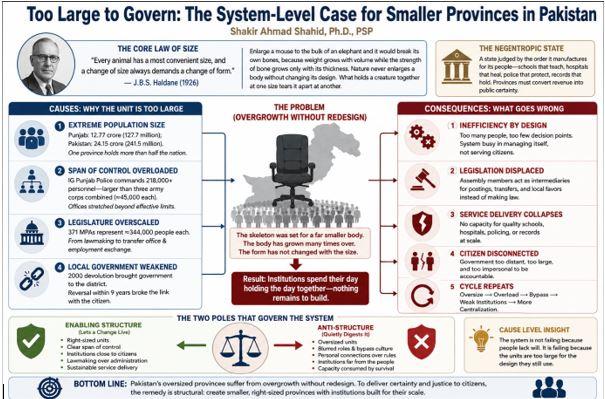
In the year 1926 the biologist J.B.S. Haldane (1892–1964) published a short essay titled “On Being the Right Size.” The whole argument of the said essay travels in one line: every animal has a most convenient size, and a change of size always demands a change of form. Enlarge a mouse to the bulk of an elephant and it would break its own bones, because weight grows with volume while the strength of bone grows only with its thickness. The elephant survives its size only by becoming a different design — pillar legs, a heavier skeleton, a slower walk. Nature never enlarges a body without changing its design. What holds a creature together at one size tears it apart at another.
Administrative units too obey this very law, and Pakistan is a living demonstration of the same. What is a province for? It exists to convert public revenue into public certainty — schools that teach, hospitals that heal, police that protect, records that hold. This is the negentropic state in one line: a state judged by the order it manufactures for its people, and judged province by province on exactly this conversion. Now place the numbers beside the purpose. Punjab, as per the census of 2023, carries 12.77 crore people — 127.7 million. That makes it the second most populous subnational unit on earth; fewer than a dozen countries of the world hold more people than this one province. Pakistan as a whole attempts to govern more than 24 crore — 241.5 million — through four provinces, and one of the four holds more than half of the entire nation also. The skeleton was set for a far smaller body. The body has grown many times over. The form has not changed with the size. Two poles shall govern everything that follows: the enabling structure, which lets a change live, and the anti-structure, which quietly digests it.
Begin with the plainest measure of overgrowth, viz. the span of control — the number of subordinates one office can direct effectively. Management science sets the limit at a handful, and every army honors it in its pyramid of section, platoon, company, division and corps. Now look at the police. As per the Statutory Annual Report of the force, the Inspector General of Police in Punjab commands more than 218,000 personnel. An army corps numbers roughly 45,000 soldiers. The provincial police chief therefore holds a command larger than three army corps combined. Yet the comparison ends at the number itself. Where a corps commander of forty-five thousand administers hospitals, schools, colleges and housing colonies for his soldiers and their children, there the commander of two hundred thousand constables cannot show one hospital, one school system or one college of the force’s own even. Other failures in professional domain need a separate full document. The difference is not of devotion; it is of design. An office stretched past its convenient size spends the whole of its day holding the day together, and nothing remains in hand with which to build.
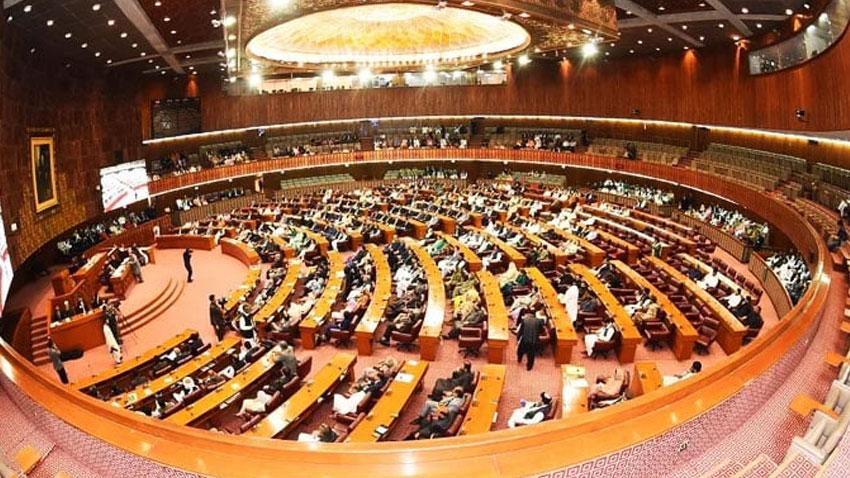
However, the police are only the most countable case. The provincial legislature is another organ which has changed its function under load. The Provincial Assembly of Punjab seats 371 members. Divide the province by the house, and every single member stands before some 3.44 lakh residents — 344,000 — a crowd no personal representation can serve. No wonder that the members do what the size of the unit rewards. They cease to legislate and begin to administer: arranging transfers and postings, interceding at the thana (the police station) and with the patwari (the village keeper of land records), and trading development funds where law should have been made. Ask any citizen what an MPA is for, and the honest answer names sifarish — intercession through connections — not legislation. The assembly was designed as a lawmaking organ; under this load it has become a transfer office and an employment exchange also. This is not a moral failure of the honorable members. It is the physiology which this anatomy makes inevitable, and the same is repeated in every giant unit of the world where a legislature stands closer to a bureaucracy than to its own citizens.
Another classic example, and the most instructive one, is the fate of the local tier. Older readers will remember the experiment. The devolution announced in August 2000 abolished the deputy commissioner and seated elected district governments under nazims (elected district mayors) in every district; the state, for the first time in its history, met the citizen at the district. Then the constitutional protection lapsed. Within a few years of 2008, every province had dismantled the district governments and restored the commissioner and the deputy commissioner. The common telling calls this the failure of an experiment. The system-level telling is more exact: the experiment was a transplant, and the body rejected it. A new organ was stitched into a body whose immune system — the provincial bureaucracy, the police command and the provincial assembly — was left standing at full strength. The host’s defenses did what defenses always do to a foreign body: they surrounded the new organ, starved it of funds and functions, and absorbed it. It’s worth noting that Article 140A of the Constitution still commands elected local government, with political, administrative and financial responsibility devolved. The tier it commands has lived ever since at the pleasure of the very offices it was built to replace. The lesson deserves to stand alone.
No reform outlives the anti-structure it left standing.
Again, the pull of the center is another face of the same overgrowth, and this one is felt in the streets. A unit of one hundred and twenty-seven million has one capital, and one capital means one center of gravity. The appellate courts, the teaching hospitals, the great universities, the secretariat and the head offices — the whole quantum of opportunity — stand in a single city. Lahore district alone now holds 1.3 crore — 13 million — people. Every family has walked this road. The mother of Rajanpur and the trader of Bahawalpur board the same long bus toward one and the same distant door — for a cardiac ward, a degree, a file — and the citizen’s nearest effective authority may sit 600 kilometers — about 370 miles — away. The pressure upon housing, schooling and medical care in the big cities is therefore not urban growth alone. It is structural funneling: the predictable flow of a giant tank with a single outlet. Mass at the center is what such a unit manufactures; certainty at the periphery is what it cannot.
The political parties are another arena wherein the size of the unit writes the outcome, because it’s the arithmetic of size which decides who can even enter the contest. A prize of the size of Punjab can be pursued only by those who already hold province-wide capital, viz. a surname known across every district, a treasury deep enough for tens of thousands of polling stations, and a bank of local notables assembled across generations. Hence the family-dominated party is not a cultural accident. It is the only organism which can digest a unit this large. Reduce the unit, and the arithmetic of entry changes with it. A schoolteacher, an engineer or a lawyer of standing can organize a province of ten or fifteen million, contest it on performance, and be judged by the very people who have watched their work. Smaller provinces are, in this exact sense, a reform of the parties before any party reforms itself: the musical chairs of a few dynasties give way to a wider floor, more chairs and new claimants.
In the actual scheme of things, the deepest question is a simple one: why has a form so visibly failing stood for so long? The answer descends below politics into design. The province at this size is the inherited machine at its original setting. A colonial administration wanted few and enormous units, because extraction and control become cheaper as the unit grows larger — one governor, one police chief and one revenue board could hold thirty million subjects, and holding was the whole function. Service reverses those economics. Delivery is done close, in units small enough that the deliverer can be seen, named and removed. In the meantime the giant province has become what every order becomes when nothing trims it back — an organ turned into an organism, a structure serving itself rather than the body, drawing revenue, posts and rents from the whole and answering no signal but its own. And its final defense is constitutional. Under Article 239(4), the division of a province cannot even be presented for assent unless two-thirds of the very assembly whose careers rest upon the undivided prize first approve it. The system has been appointed the auditor of its own reform, and no system can be the auditor of its own errors.
Admitted that division carries costs — new capitals, new assemblies, new benches of the high courts — and that a careless knife could cut along ethnic lines and deepen them; but the ledger must be read whole. Set those one-time costs against the daily, never-itemized cost of the giant unit: the bazaar of postings, the drowned local tier, the funneled cities and the laws never made. The federations of the world have already run this experiment. India carved three new states out of its largest units in November 2000 and a fourth one in June 2014, on administrative rather than ethnic lines, and not one of them has weakened the union. Nigeria walked from three regions at independence to thirty-six states. Indonesia administers thirty-eight provinces. Turkey, a state of some eighty-five million souls, runs eighty-one. What an irony that Pakistan alone attempts a quarter of a billion people through four units, and calls the attempt federalism. In actuality it is centralization with a federal flag planted upon it.
What certainty reaches the mother whose referral hospital stands six hundred kilometers from her door, and what law can an assembly write whose members spend their tenure arranging transfers and postings? What party can a person of merit build against a surname which owns a whole province, and what care can any commander give whose entire strength is consumed in holding an ungovernable span? These are one question asked four ways, and the answer is neither a better officer, nor a cleaner politician, nor a stricter court. The answer is a change of form, because the size has already changed.
In view of the foregone, the reform has four working parts, offered as proposals and not as commands. 1. Draw the new provinces on administrative and economic lines, never on ethnic ones. The existing divisions — each already carrying its commissioner, its records and its census machinery — are the natural template, and a unit of ten to twenty million stands close to the convenient size upon which the working federations of the world have settled. 2. Build the structure before the ceremony. Each new province must receive its own services under its own service laws — its own police command of governable span, its own secretariat, its own public service commission — because devolution which leaves the bureaucracy centralized is not devolution. 3. Entrench the third tier in the same amendment. Local government elections on a fixed constitutional calendar; a provincial finance award set by formula; no power of suspension left in provincial hands — so that the tier nearest the citizen no longer lives at the pleasure of the anti-structure. 4. Let the design be drawn by hands outside the offices being divided — a commission of the federation answerable to Parliament — and carried under Article 239(4) through a consensus of the parties, because offices asked to divide themselves shall otherwise absorb this reform exactly as they absorbed the last one.
However, a schedule is only half of a design. The other half is caution, and the caution must be learned from the record of reforms which have already died. Consider the record. The administrative reforms of 1973 abolished the elite service of the day and unified the grades; within a generation, the abolished service had reconstituted itself under new names, and the lateral induction of specialists which came with the reform was discredited and quietly buried. The Police Order of 2002 created public safety commissions and separated investigation from watch and ward; it was amended within two years, and after 2010 the provinces walked by stages back toward the Act of 1861 — a reform which changed the container and never the contents. The Eighteenth Amendment struck whole subjects from the center by the Constitution itself; within a few years, ministries of education, health, food security and climate had been recreated at the center under new names, on the plea of coordination and national policy, because a federal cadre can reach its top grade only where a federal ministry exists for it to head. Add the devolution of 2001, whose fate this essay has already walked, and the pattern admits of one reading. Every reform was routed through the very machinery it sought to reform. The machinery did what a living structure always does with a foreign body: it absorbed it — gradually, politely, and always under the shadow of public representation, so that on the death certificate of each reform stand the signatures of elected hands.
Hence the first caution: dismantle the top before multiplying the bottom, otherwise the new provinces shall make the top heavier still — and the top is already far too heavy. The federal secretariat today runs more than thirty ministries and nearly forty divisions, a full generation after the Constitution removed the concurrent subjects from its charge. Even the sitting government’s own ‘rightsizing’ — one and a half lakh vacant posts — 150,000 — abolished, ministries merged — is a trimming by notification, and what one notification trims, the next can regrow. The counter must therefore be written into the same amendment which creates the provinces. Confine the federation to the genuinely federal subjects — defense, foreign affairs, currency, mines and minerals, inter-provincial coordination and communications of national reach. Bring its ministries below eight. And enact the bar in plain words: the federation shall take no further subject and create no further ministry or division except by the same supermajority which created the provinces. A country cannot lighten its limbs while fattening its head.
The second caution concerns the manner of the machine’s counterattack, because a bureaucracy never resists a popular reform frontally. It is adept in defeating every reform gradually, by moving under the shadow of public representation, and its instrument is the ratchet asymmetry of the state: what is struck by constitution grows back by notification, and the posts which return first are the apex posts, because the career ladder of the cadre cannot stand without them. Here too the movement is predictable in advance. New ministries at the center ‘to coordinate the new units.’ New directorates. New additional secretaries and special secretaries multiplying beneath them. A fresh layer of coordinators settling upon every layer of producers, and each new province handed a smaller copy of the old secretariat — the whole of it notified in the rules of business and voted upon nowhere. The counters are establishment ceilings written into the founding statute itself: the total of senior posts capped in the law and published every year against measured output; every new post of grade nineteen and above created by legislation and never by notification; a sunset clause — an automatic date of expiry — upon every coordination body; and the design held, from first to last, in hands which stand outside the offices being divided. The transplanted organ survived nowhere that the immune system was left armed. This time the immune system itself must be operated upon first.
The third caution concerns the tenants of the new houses, because a new province staffed by the old generalist cadre would be the old province in a new dress. The counter is technical induction, made a founding condition and not a later hope. Let economists head the finance and the economic departments, engineers the works and irrigation, physicians the public health, and educationists the schooling — the specialist to head and the generalist to assist — with lateral entry through transparent examination and with protected tenure, so that the induction is not strangled in its first posting as the lateral entry of the 1970s was. No ministry of money should stand without an economist at its head. The country has paid the price of that vacancy in every decade of its existence.
Last but not the least, the cruelest danger is that everything above may change while nothing changes at the two counters where the citizen actually stands: the courtroom of the civil judge and the front desk of the thana. Walk into any district kachehri (the district court compound) on a working morning, and the queue tells the truth of the state. Nearly 1.86 million cases wait today in the district courts alone — more than four-fifths of the nation’s entire judicial backlog — and the station still runs upon the registers and the discretion which the Act of 1861 designed for control rather than for service. Hence the founding law of each new province must carry the floor with it. Raise the strength of the district judiciary at a fixed ratio to population; publish time standards for disposal court by court; fill the vacancies before any bench is inaugurated. And at the station: protected tenure for the station house officer, the separation of investigation from watch and ward made real rather than merely notified, and the record of custody made digital and open to inspection. A reform which never reaches the counter where the citizen stands is, in the citizen’s arithmetic, no reform at all — and it’s the citizen’s arithmetic which shall decide whether the new provinces are remembered as a founding or as a reshuffle.
Summing up, Haldane’s law waits at the end as it stood at the beginning: a change of size demands a change of form, and nature grants no exemption to any nation. The skeleton of a few giant units was set for a body of 3.37 crore — 33.7 million — people. The body now weighs more than 24 crore — 241.5 million. And the bones are breaking at exactly the joints this essay has walked upon: a force which cannot care for its own, assemblies which cannot legislate, cities which cannot breathe, parties which cannot democratize, and a local tier which cannot survive its own creation. Smaller provinces are therefore not a concession to the grievance of any region. They are the enabling structure of every other reform which this country has attempted and lost — provided the cautions above stand in the founding law itself, because the machine which absorbed every earlier reform is already waiting for this one. A federation that refuses devolution is not governing its people; it is ruling them from a greater distance.
-- The writer is a Fulbright alumnus in forensic science and Criminology at John Jay College of Criminal Justice, New York. Across some eighteen years of service, he has worked in rural development, investment, policing, investigation, intelligence and counterterrorism at both policy and operational levels. He is the founder of Institute for Forensic Reliability Governance and the author of the multi-volume Cognitive Freedom Series and Just Order Series, which examine the architecture of mental control and the design of correctable institutions.
The writer can be reached at malikaaarsalan@gmail.com.
Disclaimer: The views expressed in this article are those of the author and do not necessarily reflect the official policy or position of www.gnnhd.tv

Jodar apologises for swearing at ball kid in Shanghai
- 2 دن قبل

Will November stop Trump’s agenda?
- ایک دن قبل

Here are all the new HomePod Mini 2 colors
- ایک دن قبل

Cold weather and high prices could flip the Senate
- ایک دن قبل

Trump’s revenge campaign comes for Ilhan Omar
- ایک دن قبل

Character.AI files for bankruptcy
- ایک دن قبل

Hands-on with the Apple Home Collection
- 21 گھنٹے قبل

The Ocarina of Time remake feels remarkably modern — and surprisingly terrifying
- ایک دن قبل
Pakistan warns India against any misadventure: FO
- 2 دن قبل

West Bank settlers brutally attack a Washington Post journalist
- 4 گھنٹے قبل

Florida’s uniquely horrifying death penalty system
- ایک دن قبل

Buying Apple’s wall-mounted HomeView? The mount costs extra
- 21 گھنٹے قبل