Many of the hundreds of companies reopening factories in Shanghai in recent weeks have faced challenges getting production lines back up to speed while keeping workers on-site in a "closed loop" system.

SHANGHAI: Tesla operated its Shanghai plant well below capacity on Tuesday, showing the problems factories face trying to ramp up output under a tightening COVID-19 lockdown, while China's capital kept up its fight with a small but stubborn outbreak.
Many of the hundreds of companies reopening factories in Shanghai in recent weeks have faced challenges getting production lines back up to speed while keeping workers on-site in a "closed loop" system.
Even if they manage to get everything right, such firms depend on suppliers facing similar challenges.
The latest sign of the struggle trying to increase output under COVID rules came at Tesla's Shanghai plant, where a resumption of work three weeks ago got extensive state media coverage as an example of what can be achieved despite restrictions.
The U.S. automaker has halted most of its production at the plant due to problems securing parts, according to an internal memo seen by Reuters.
Tesla had planned as late as last week to increase output to pre-lockdown levels by next week.
Among Tesla suppliers facing difficulties is wire harness maker Aptiv (APTV.N) after infections were found among its employees, sources said on Monday. read more
Videos posted online last week showed dozens of workers at Apple and Tesla supplier Quanta overwhelming hazmat-suited security guards and vaulting over factory gates fearing being trapped inside by a lockdown.
COVID curbs in Shanghai, Beijing and dozens of other major manufacturing hubs across China are taking a heavy toll on the world's second largest economy, with significant knock-on impacts on global trade and supply chains.
Uncertainty is high, with economists unable to say with any accuracy when the country will bring COVID under control and what the final cost is likely to be.
"Growth in China is likely to remain hostage to the course of the pandemic for most of the year," analysts at Fathom Consulting said in a note.
Chinese stocks (.CSI300) were just off two-year lows, and the yuan traded near 18-month lows on Tuesday.
Shanghai, a vital centre for commerce, finance and manufacturing for China and beyond with a population of 25 million, was enduring its sixth week of a city-wide lockdown.
The prolonged isolation increasingly jars with an outside world which is gradually returning to its pre-COVID way of life, even if cases spread.
China has threatened actions against critics of its "dynamic-zero COVID" policy, which it says aims to "put life first" and prevent a death toll like ones seen around the world.
BEIJING ON HIGH ALERT
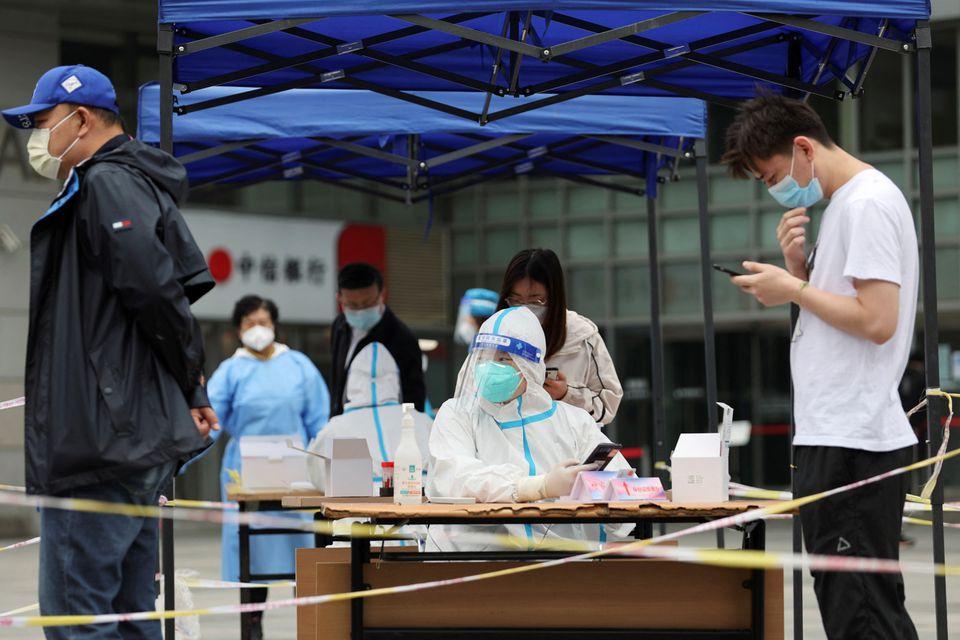
Testing was becoming daily routine in much of Beijing and other places in China.
The capital has not seen its daily case numbers grow beyond several dozen since its latest outbreak began on April 22. But it has also found it difficult to bring them down significantly.
So restrictions have gradually tightened.
An area in the southwest of the capital on Monday banned residents from leaving their neighbourhoods and ordered all activity not related to virus prevention to stop.
Elsewhere, some residents have been told to work from home; dine-in services at restaurants were banned; parks, some malls and other venues were shut; some bus and subway routes were curtailed; isolated lockdowns were enforced on some buildings.
The number of new COVID cases in Shanghai has been falling for almost two weeks, but remains in the thousands and restrictions are tightening.
"We are still in a critical period of epidemic prevention," said Sun Xiaodong, deputy director of the Municipal Centre for Disease Control.
FINAL PUSH
The city was making what it hoped was a final push to end infections outside areas under the strictest curbs - the most significant gauge of whether the virus was being brought under control.
Many residential compounds have received notices that people would no longer be allowed out, having been able to go for brief walks or quick grocery trips previously.
In some cases, entire communities have been sent into quarantine after just one member tested positive.
Ruthless enforcement has fuelled resentment.
A former Southern Weekender journalist, Lian Qingchuan, described in a WeChat post how he tried in vain for several days to convince authorities to let him visit his dying mother in another province without having to quarantine first.
His mother died before he could see her, which, he said, filled him with rage.
"I wanted to be a filial person, but they have turned me into an ungrateful person who is worse than a beast,” he wrote in the post, which was taken down soon after it appeared.
“I know exactly who my enemies are.”
He declined comment when contacted by Reuters.
SOURCE: REUTERS

Microsoft 365 Family subscribers will finally be able to share AI benefits
- an hour ago

Gold prices decline after one day's increase in Pakistan
- 14 hours ago
Two US cities could soon ban one of the world’s most controversial foods
- a day ago
National Assembly passes resolution endorsing federal govt's imposition of emergency, governor's rule in KP
- 16 hours ago

CDF Munir reaffirms resolve to strengthen Pakistan-Russia ties
- 10 hours ago

K-pop star Sunmi loves Notion and ear cleaning videos
- an hour ago

Anthropic launches free AI security scans for open-source projects
- a day ago

Nobel Peace Prize winner Navi Pillay blasts Trump's 'unlawful' sanctions against ICC
- 10 hours ago
The liver transplant system tried to fix its sex bias. Did it work?
- a day ago

Pakistan, Oman vow to expand bilateral cooperation in multiple fields
- 13 hours ago

Hands-on with Amazon’s Alexa Tablet 12 Pro and its wild new matte display
- a day ago
‘Pure insanity’: Mathematicians will need years to make sense of OpenAI’s latest drop
- an hour ago