
Scientists say record heat, flash floods, droughts are becoming more frequent and intense due to climate change

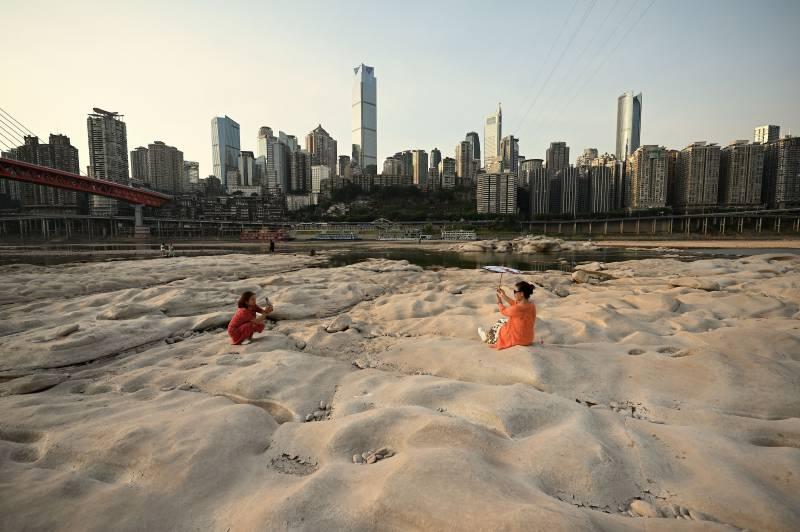
Chongqing: Half of China's vast territory is now experiencing drought, including parts of the frigid Tibetan Plateau, official data showed -- with more high temperatures forecast Thursday for hundreds of millions of people enduring the country's hottest summer on record.
The world's second-largest economy has been hit by record heat, flash floods and droughts -- phenomena that scientists say are becoming more frequent and intense due to climate change.
Southern China has recorded its longest continuous period of high temperatures since records began more than 60 years ago, the agriculture ministry said this week.
Experts have said the intensity, scope and duration of the heatwave could make it one of the worst recorded in global history.
A chart from the National Climate Centre showed Wednesday that swathes of southern China -- including the Tibetan Plateau -- were experiencing "severe" to "extraordinary" drought conditions.
The worst-affected area -- the Yangtze river basin, stretching from coastal Shanghai to Sichuan province in China's southwest -- is home to over 370 million people and contains several manufacturing hubs including the megacity of Chongqing.
The China Meteorological Administration predicted continued high temperatures of up to 40 degrees Celsius (104 degrees Fahrenheit) in Chongqing and the provinces of Sichuan, Jiangxi and Zhejiang Thursday.
China's State Council on Wednesday announced a 10 billion yuan ($1.45 billion) subsidy to support rice farmers experiencing drought conditions which authorities have warned pose a "severe threat" to this year's autumn harvest.
China produces more than 95 percent of the rice, wheat and maize it consumes, but a reduced harvest could mean increased demand for imports in the world's most populous country -- putting further pressure on global supplies already strained by the conflict in Ukraine.
Officials also called for "a combination of measures to increase water sources to fight drought, first ensure drinking water for the people, ensure water for agricultural irrigation," the readout added.
Wednesday's CCTV evening news broadcast showed trucks supplying villagers who lacked drinking and agricultural water in rural Sichuan and Chongqing, with remote mountain areas particularly hard hit.
Temperatures as high as 45 degrees Celsius (113 Fahrenheit) have led multiple Chinese provinces to impose industrial power cuts, as cities struggle to cope with a surge in demand for electricity partly driven by people cranking up the air conditioning.
Record low water levels on the Yangtze River have also put pressure on the region's hydropower generators.
The heat broke records in Sichuan, where a temperature of 43.9 degrees Celsius (111 Fahrenheit) was recorded Wednesday afternoon, the province's Meteorological Service Centre said in a statement.
SOURCE: AFP

Saudis pound Yemen, Houthis fire at Saudi, as Middle East war spreads
- 14 hours ago

Amazon’s Fire TV Stick 4K is over half off at under $20
- 4 hours ago

Pakistan lodges protest after Indian Navy's provocative action in EEZ
- 6 hours ago

CDF Munir stresses tech innovation for national security
- 11 hours ago

The one thing you can do to help a whole lot of animals, explained in 4 charts
- 2 hours ago

Sylvan Esso think you should splurge on good-quality yogurt
- 4 hours ago

Trump’s Kennedy Center sabotage is complete
- 2 hours ago

New York City’s last pickpocket doesn’t need a smartphone
- 4 hours ago

The successful campaign to make a terrifying Supreme Court immigration case disappear
- 2 hours ago

StarCraft returns in 2030 as an open-world shooter
- 4 hours ago

Apple is reportedly working on iPhone game controllers
- 4 hours ago

How your pet can help you tap into a sense of spirituality
- 2 hours ago