Jeremy Hunt says the measures would reassure markets that the government and the Bank of England are now working in “lockstep”

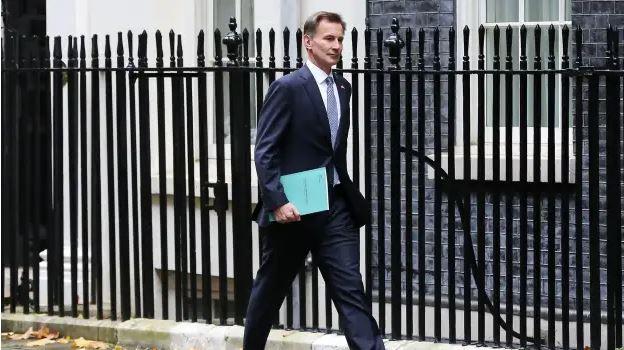
The U.K. government on Thursday unveiled a sweeping £55 billion ($66 billion) fiscal plan as it seeks to plug a gaping hole in the public finances and restore Britain’s economic credibility, even as the country teeters on recession.
Finance Minister Jeremy Hunt, in his hotly anticipated inaugural Autumn Statement, outlined around £30 billion in spending cuts and £25 billion in tax hikes.
The measures included an extra two-year freeze on income tax thresholds and a lowering of the top rate of income tax to £125,140 — moves directly opposed to the major cuts touted in September’s catastrophic mini-budget.
“Unfunded tax cuts are as risky as unfunded spending,” Hunt told the House of Commons.
Hunt said the measures would reassure markets that the government and the Bank of England are now working in “lockstep.”
“We need fiscal and monetary policy to work together,” he said. “That means the government and the Bank working in lockstep. It means, in particular, giving the world confidence in our ability to pay our debts.”
Sterling fell against the dollar following the announcement. It was trading at around $1.1811 by 1:30 p.m. local time.
A recessionary fiscal plan
The measures will increase financial hardship on millions of Britons as they confront the country’s worst cost-of-living crisis in decades and its longest-ever recession.
However, Hunt said they were necessary to limit 41-year-high inflation and recover the U.K.’s reputation; dubbing the plan the “ultimate growth strategy.”
″We must continue a relentless fight to bring (inflation) down, including a rock-solid commitment to rebuild our public finances,” Hunt said.
Among the other measures announced were a 10% increase in the state pension, benefits and tax credits — in line with September’s inflation figure — and an increase in the National Living Wage to £10.42 an hour for those aged 23 and above.
The U.K.’s Autumn Statement sets the tone for Prime Minister Rishi Sunak’s premiership, as he presides over a new era of fiscal austerity.
The dividend allowance and the annual exception for capital gains tax, meanwhile, will be cut over the next two years, the finance minister said.
He also confirmed that the energy industry will face an expanded windfall tax of 35% up from 25%. Meantime, household support for energy bills will be cut back, with typical bills rising from £2,500 a year to £3,000 from April 2023.
Still, many of the fiscal measures are scheduled for the years after an expected 2024 general election.
Thursday’s statement was accompanied by a long-awaited set of projections from the U.K.’s independent Office for Budget Responsibility (OBR), which painted a gloomy economic picture for Britain.
The forecasts show that the U.K. is now in a recession, which it expects to last “just over a year,” and during which employment will rise from 3.5% to 4.9%.
Hunt said the government’s new plan ensures that the downturn is shallower and unemployment lower than previously forecast.
Major test for the government
The U.K.’s strategy sets the tone for Prime Minister Rishi Sunak’s premiership, as he presides over a new era of fiscal austerity and dwindling Conservative Party support.
It also marks a defining moment for Hunt, who was installed last month to recover the U.K.’s credibility after predecessor Kwasi Kwarteng’s now-infamous mini-budget of unfunded tax cuts unleashed market chaos and emergency intervention.
Though Hunt’s then-boss Liz Truss resigned in short order — becoming the U.K.’s shortest-serving prime minister — he was kept on by successor Rishi Sunak in a bid to ensure stability following months of political turmoil.
Shadow finance minister Rachel Reeves said Thursday that the new plans will leave the U.K. still worse off than it was earlier this year.
“Here we are at the end of 2022, three prime ministers, four chancellors and four budgets later,” Reeves said. “And where do we find ourselves? In a worse place than we started the year.”
The U.K. is the only Group of Seven (G7) country yet to return to its pre-pandemic size, having suffered a decade of near-stagnant income growth.
The Bank of England warned earlier this month that the U.K. is now facing its longest recession since records began a century ago.
Official data released Friday showed that the economy shrank by 0.2% in the third quarter of 2022. A second consecutive quarter of negative growth going forward would indicate that the U.K. is in a technical recession.
SOURCE: CNBC

PIA faces over Rs10mn in baggage delay penalties at airports across Pakistan
- a day ago
Why Americans are warming to China
- 2 days ago

China, US agree to $30bn tariff cut, AI dialogue during Xi visit
- a day ago

Security forces kill 33 terrorists in Balochistan: ISPR
- 2 days ago
Susan Collins is the abortion rights movement’s biggest test of 2026
- 2 days ago

Pakistani, Saudi, Turkish military chiefs discuss ways to back KSA under Makkah defence pact
- 2 days ago
Any attempt to divert Pakistan's share of waters will be treated as an act of war: PM Shehbaz
- 2 days ago

Pakistan Customs foils smuggling attempt at Islamabad Airport, seizes contraband worth Rs660mn
- a day ago
More Republicans are breaking from Trump. Is it too little, too late?
- 2 days ago

Soldiers can refuse to commit war crimes. Can AI?
- 4 hours ago

A sinkhole swallowed Nicolas Cage’s driveway. Yours might be next.
- 2 days ago

Malaysia beat Pakistan by 5-4 goals in Asian Games match
- a day ago