South Korea, Iran summon each other's envoys as spat over Yoon remarks deepens

Seoul: Iran and South Korea summoned each other's envoys in a deepening spat over comments by South Korean President Yoon Suk-yeol that described the Islamic republic as the enemy of the United Arab Emirates.
Yoon, speaking to South Korean troops stationed in Abu Dhabi earlier this week, said South Korea and the UAE are under "very similar" circumstances, each facing North Korea and Iran as "the enemy, biggest threat."
Relations between Seoul and Tehran had already been testy over frozen Iranian funds in South Korea and suspected arms dealings between Iran and North Korea.
Yoon's office has said his comment was intended as words of encouragement for South Korean soldiers while the foreign ministry said on Thursday it had repeatedly offered explanations to Tehran.
Unappeased, Tehran summoned South Korean ambassador Yun Kang-hyeon on Wednesday, warning that bilateral ties could be reviewed if the issue was not resolved, according to a report from Iran's official IRNA news agency.
Iran's deputy foreign minister for legal affairs, Reza Najafi, told Yun that Iran has "deep-rooted and friendly relations" with most neighbours. He described Yoon's comment as "interfering", adding that Yoon was "undermining peace and stability in the region," the report said.
It added that Najafi also accused Seoul of pursuing an "unfriendly approach" toward Iran, and mentioned the issue of frozen funds. Iran has repeatedly demanded the release of some $7 billion of its funds frozen in South Korean banks under U.S. sanctions.
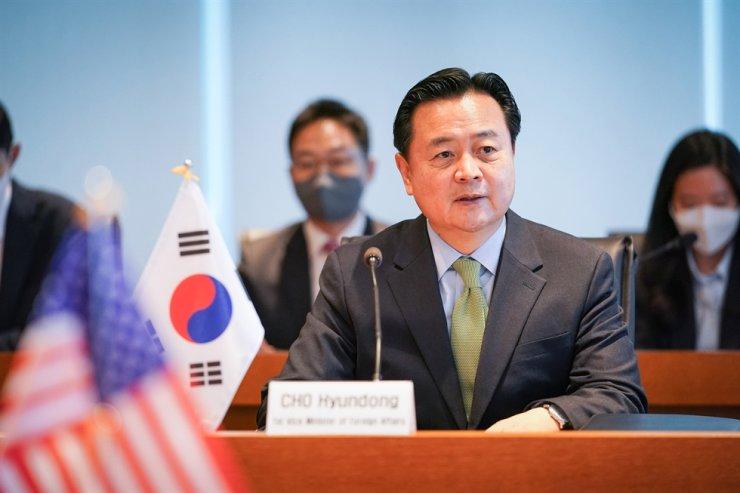
Hours later on Thursday, South Korea's foreign ministry said its vice minister Cho Hyun-dong had called in Iran's ambassador in Seoul, Saeed Badamchi Shabestari, to complain about Najafi's remarks.
The ministry said Najafi had made a "completely groundless" claim that Yoon had hinted at developing a nuclear weapon.
Yoon said last week that Seoul might have to push to redeploy U.S. tactical nuclear weapons or build its own bombs to deter North Korea, but is working instead to improve joint planning and execution of so-called U.S. extended deterrence or military capability including nuclear forces as a "realistic, achievable" means.
"Our president's remarks were intended to strengthen the effectiveness of the extended deterrence to counter North Korea's escalating nuclear and missile threats," ministry spokesperson Lim Soo-suk told a briefing.
Yoon's remarks could also spell headaches for him domestically. Opposition lawmakers have accused him of causing a "diplomatic disaster," while some members of Yoon's own party have also said he should have been more careful.
Seoul and Tehran have been in talks over ways to unfreeze the funds and about the resumption of Iranian oil imports. South Korea was once one of Iran's biggest crude buyers in Asia, but ceased imports after Washington imposed sanctions on Tehran in 2018.
SOURCE: REUTERS

How your pet can help you tap into a sense of spirituality
- 2 hours ago
Trump’s Kennedy Center sabotage is complete
- 2 hours ago

The successful campaign to make a terrifying Supreme Court immigration case disappear
- 2 hours ago

New York City’s last pickpocket doesn’t need a smartphone
- 4 hours ago

Amazon’s Fire TV Stick 4K is over half off at under $20
- 4 hours ago

Saudis pound Yemen, Houthis fire at Saudi, as Middle East war spreads
- 15 hours ago

The one thing you can do to help a whole lot of animals, explained in 4 charts
- 2 hours ago
Pakistan lodges protest after Indian Navy's provocative action in EEZ
- 7 hours ago

StarCraft returns in 2030 as an open-world shooter
- 4 hours ago

Apple is reportedly working on iPhone game controllers
- 4 hours ago

Sylvan Esso think you should splurge on good-quality yogurt
- 4 hours ago
CDF Munir stresses tech innovation for national security
- 11 hours ago