- Home
- Technology
- News
South Korea’s first lunar orbiter launched by SpaceX
It was launched from Cape Canaveral in Florida

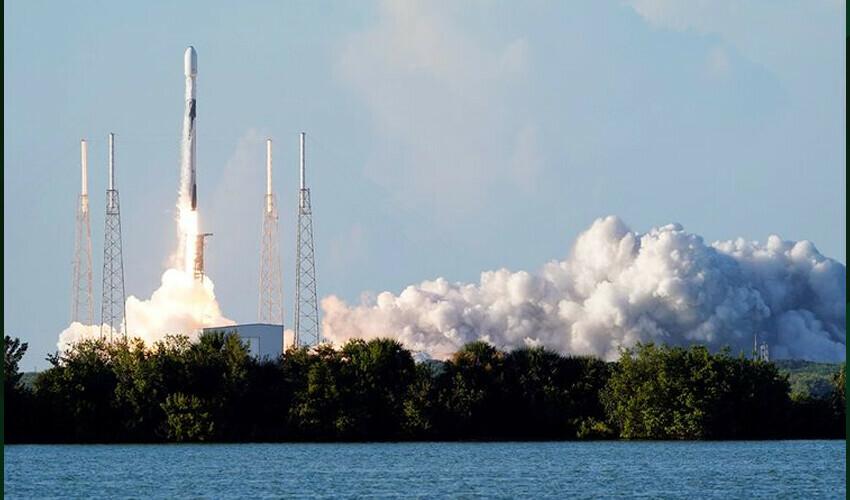
Seoul: South Korea’s first lunar orbiter successfully launched on a year-long mission to observe the Moon, Seoul said Friday, with the payload including a new disruption-tolerant network for sending data from space.
Danuri – a portmanteau of the Korean words for “Moon” and “enjoy” – was on a Falcon 9 rocket launched from Cape Canaveral in Florida by Elon Musk’s aerospace company SpaceX. It aims to reach the Moon by mid-December.
“South Korea’s first lunar orbiter ‘Danuri’ left for space at 8:08 am on August 5, 2022,” Seoul’s science ministry said in a tweet, sharing a video of the rocket blasting off trailing a huge column of smoke and flames.
Danuri “successfully entered orbit towards the moon”, Seoul’s vice science minister Oh Tae-seok told reporters later Friday, saying that researchers were already communicating with Danuri through NASA’s deep-space antenna in Canberra, Australia.
“Analysis of the received satellite information confirmed that Danuri’s solar panel was properly unfolded to start power generation,” he said, adding everything appeared to be going smoothly.
Danuri will use six different instruments, including a highly sensitive camera provided by NASA, to conduct research, including investigating the lunar surface to identify potential landing sites.
One of the instruments will evaluate disruption-tolerant, network-based space communications, which, according to South Korea’s science ministry, is a world first.
BTS in space
Danuri will also try to develop a wireless Internet environment to link satellites or exploration spacecraft, Seoul has said.
The lunar orbiter will stream K-pop sensation BTS’ song “Dynamite” to test this wireless network.
Scientists also hope Danuri will find hidden sources of water and ice in areas of the Moon, including the permanently dark and cold regions near the poles.
“This is a very significant milestone in the history of Korean space exploration,” said Lee Sang-ryool, head of the Korea Aerospace Research Institute, in a video shown before the launch.
“Danuri is just the beginning, and if we are more determined and committed to technology development for space travel, we will be able to reach Mars, asteroids, and so on in the near future.”
South Korean scientists say Danuri – which took seven years to build – will pave the way for the nation’s more ambitious goal of landing on the Moon in the next decade.
“South Korea will become the seventh country in the world to have launched an unmanned probe to the Moon,” an official at the Korea Aerospace Research Institute told AFP.
“We hope to continue contributing to the global understanding of the Moon with what Danuri is set to find out.”
Lunar ambitions
Danuri was launched by a private company – SpaceX – but South Korea recently became one of a handful of countries to successfully launch a one-tonne payload using their own rockets.
In June, the country’s homegrown three-stage rocket nicknamed Nuri – a decade in development at a cost of 2 trillion won ($1.5 billion) – launched successfully and put a satellite into orbit, on its second attempt after a failure last October.
That launch – coupled with Danuri’s launch Friday – helps bring South Korea ever closer to achieving its space ambitions.
In Asia, China, Japan and India all have advanced space programmes – and the South’s nuclear-armed neighbour North Korea has also demonstrated satellite launch capability.
Ballistic missiles and space rockets use similar technology and Pyongyang put a 300-kilogram (660-pound) satellite into orbit in 2012 in what Washington condemned as a disguised missile test.
SOURCE: AFP

VisionQuest is what happens when AI really goes rogue
- 16 hours ago

Laika has spent 20 years building up to Wildwood
- 3 hours ago

Zen Browser is the Arc replacement I was looking for
- 3 hours ago

It’s time to find a new browser
- 3 hours ago

Republicans are trying to make the Texas Senate race about “manliness”
- 42 minutes ago

Can Trump block the Alaska Senate election?
- 42 minutes ago

Can machines be war criminals?
- 42 minutes ago

Microsoft’s new Surface Laptop Ultra update fixes reboot and display bugs
- 3 hours ago

France eyes investment in Pakistan’s power transmission network
- 7 hours ago

OpenAI announces three big science discoveries and a new way to work with academics
- 3 hours ago

France eyes investment in Pakistan’s power transmission network
- 7 hours ago

Meta delays new business terms after publisher pushback on AI scraping
- 3 hours ago