
One of the first casualties of the second Trump administration has been the United States Agency for International Development (USAID). The agency, which funds and operates humanitarian aid programs all across the world, has quickly become a target for Repub…

Published 2 years ago on Feb 17th 2025, 12:00 pm
By Web Desk
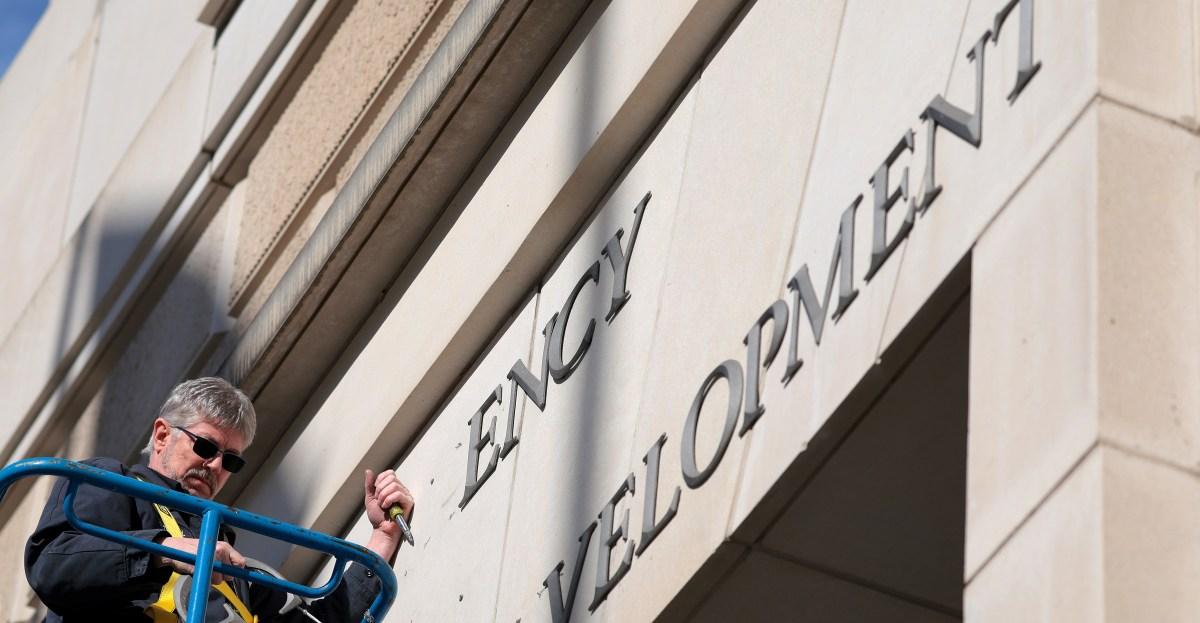
One of the first casualties of the second Trump administration has been the United States Agency for International Development (USAID).
The agency, which funds and operates humanitarian aid programs all across the world, has quickly become a target for Republicans. Over the past four weeks, the White House has been pursuing a plan to reduce USAID’s workforce from over 10,000 people to just about 290. The effort has gone so far that, in Washington, DC, signs for the agency have either been covered in black tape or removed entirely.
There are plenty of reasons why the Trump administration — and Elon Musk’s so-called Department of Government Efficiency (DOGE) — might be so fixated on USAID specifically. It could be part of their effort to dramatically reduce federal spending, using USAID as a trial run before dismantling other government agencies. Or it could be that Trump and his allies see little value in foreign aid. But if this really was a case of saving taxpayer money, as they claim, it doesn’t make much sense; in the last fiscal year, USAID spent less than 1 percent of the federal budget.
But the Trump administration’s assault on USAID does tell us something broader about Republicans’ view on government spending — specifically, what they might consider to be wasteful spending: programs that help the poor. And the way they have justified the dismantling of USAID — by categorizing it as rife with fraud and mismanagement — may give us a glimpse into how they will approach domestic welfare programs.
A statement from the White House earlier this month lamented that USAID has, apparently, “been unaccountable to taxpayers as it funnels massive sums of money to the ridiculous — and, in many cases, malicious — pet projects of entrenched bureaucrats.”
It doesn’t matter that the billions of dollars that USAID spends have supported life-saving food distribution and STD-prevention programs. And it doesn’t matter that USAID’s famine warning system helps organizations around the world determine where to deploy humanitarian relief. What matters to Trump and his allies are the stories — some of which, it should be noted, aren’t even true — that support their argument that basic humanitarian assistance programs are riddled with waste and abuse.
Effectively shutting down USAID will have major consequences for millions of people abroad, and it should also serve as a warning for people who care about antipoverty programs here at home. When programs like food stamps or Medicaid are on the chopping block, chances are Republicans are going to turn to the same argument: These programs are wasteful, so why should we fund them?
USAID today. Medicaid tomorrow?
Throughout the presidential campaign, Trump promised not to cut programs like Medicare and Medicaid, but the red flags were hard to miss. “There is a lot you can do in terms of entitlements, in terms of cutting and in terms of also the theft and the bad management of entitlements,” he told CNBC in March of last year.
And that’s exactly how Trump and his allies are framing their potential attacks on Medicaid now. (Unlike USAID, Medicaid is nearly 10 percent of the federal budget, making it a more appealing target for the Trump administration if they’re looking to drastically cut spending.) He recently told reporters that he’ll “love and cherish” Medicaid, but added one caveat: “We’re not going to do anything with that,” he said, “unless we can find some abuse or waste.”
Sure enough, when Trump nominated Dr. Mehmet Oz to serve as the administrator of the Centers for Medicare and Medicaid Services (CMS), he said that Oz would “cut waste and fraud within our country’s most expensive government agency.” And earlier this month, Musk’s DOGE aides started working at CMS, where, according to the Wall Street Journal, they’ve gained access to critical payment and contracting systems. The DOGE aides have been tasked with finding fraud.
To be sure, Medicaid and Medicare, like any government program, are by no means perfect and do experience fraud and mismanagement. But the Trump administration is greatly exaggerating how much money they will save by tackling fraud in these programs. “At this point, I am 100% certain that the magnitude of the fraud in federal entitlements (Social Security, Medicare, Medicaid, Welfare, Disability, etc) exceeds the combined sum of every private scam you’ve ever heard by FAR,” Musk tweeted last week. “It’s not even close.”
That claim, however, isn’t rooted in reality, unless Musk knows something we don’t and isn’t sharing it. One number that the government often cites when evaluating these programs’ efficiency is the “improper payment rate,” which represents payments that don’t meet CMS requirements for various reasons, including insufficient documentation, overpaying, or underpaying. In 2024, Medicaid’s improper payment rate was roughly 5 percent. While some of that might be a result of fraud, abuse, or mismanagement, the vast majority of it is a result of insufficient documentation, according to a CMS report.
The problem is that if Republicans are truly concerned with wasteful spending, they wouldn’t focus their efforts on restricting welfare access by imposing measures like work requirements, which have been proven to be ineffective. When Georgia imposed its work requirements on Medicaid, for example, its administrative costs ballooned, with the majority of its Medicaid spending going toward implementing its work reporting requirements.
Republican efforts to scale back Medicaid and other welfare programs have never been about stopping fraud or abuse. They’ve always been about shrinking the social safety net, in part to help fund tax cuts for people who don’t need them. And with Musk’s plan to cut some $2 trillion in government spending, it’s clear the road to getting even remotely close to that figure goes through entitlement cuts. Like the attack on USAID, Republicans will say they’re simply targeting fraud and abuse, but their definition of wasteful spending will likely have less to do with actual waste or corruption and more to do with money that goes toward helping the poor.
This story was featured in the Within Our Means newsletter. Sign up here.

OpenAI cancels release of newest model due to safety concerns
- 13 hours ago
Buttler ruled out of Pakistan Tri-series with hamstring injury
- 15 hours ago

Meta’s next VR device isn’t a headset — it’s glasses
- 33 minutes ago

Honor’s Magic 9 Pro Max has a big camera and a bigger battery
- 33 minutes ago

Big Oil has an audacious request for the Supreme Court
- a day ago

Pakistan Army team successfully performs complex brain surgery in Gwadar
- 15 hours ago

Control Resonant gets tough, but gives you the tools to deal with it
- 33 minutes ago
OpenAI agents hacked an Australian government website in search for data
- 33 minutes ago

Jensen Huang talks about AI and climate change like a supervillain
- a day ago

Saudi Arabia resumes Yanbu oil loading after pipeline restart
- 8 hours ago

Muse sure looks a lot like OpenClaw
- 33 minutes ago

Global financial institutions express confidence in Pakistan's economic reforms
- 9 hours ago
You May Like




Trending