Conference highlights India’s increasing reliance on proxy warfare after suffering significant defeat during brief May conflict with Pakistan

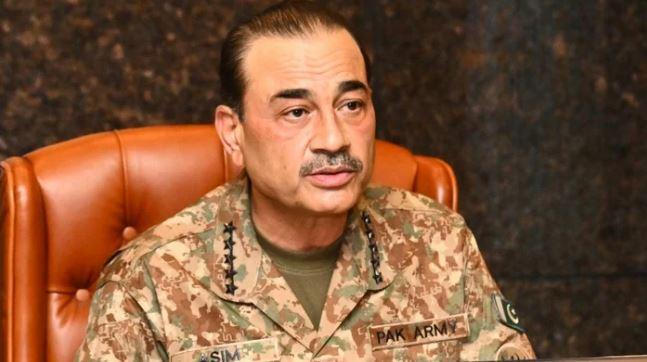
Rawalpindi: The Pakistan Army’s senior leadership has reaffirmed its determination to take decisive and comprehensive measures against Indian-backed terrorist proxies, according to a statement issued by the Inter-Services Public Relations (ISPR) on Thursday.
The resolve came during the 271st Corps Commanders’ Conference (CCC) held at the General Headquarters (GHQ) in Rawalpindi, chaired by Chief of Army Staff (COAS) Field Marshal Syed Asim Munir. The forum conducted a thorough review of internal and external security dynamics, with a strong focus on India’s escalatory behavior following its recent military setback.
According to ISPR, the conference highlighted India’s increasing reliance on proxy warfare after suffering a significant defeat during the brief May conflict with Pakistan. The war was triggered when India launched strikes on Pakistan, accusing Islamabad of orchestrating an attack on tourists in Pahalgam, located in Indian Illegally Occupied Jammu and Kashmir — an allegation Pakistan has categorically denied.
Although the direct military confrontation lasted only 90 hours, ending with a strong and decisive response from Pakistan, the country’s leadership maintains that India has continued its aggression through covert means. The government accuses New Delhi of sponsoring multiple terrorist attacks inside Pakistan via its proxy networks since the cessation of hostilities.
The Corps Commanders offered Fateha for the martyrs of recent attacks attributed to Indian-sponsored proxies. The forum resolved that the sacrifices of these Shuhada (martyrs) would not be in vain, and emphasized that safeguarding the people of Pakistan remains the top priority of the country’s armed forces.
“Taking stock of recent successes against terrorist proxies, the forum resolved that the blood of our Shuhada will not go to waste,” the ISPR statement read. It added that the army will continue to confront threats at all levels with unwavering resolve.
The forum further noted that, in the aftermath of its military failure, India is intensifying efforts to advance its “nefarious agenda” through groups it described as Fitna al-Khawarij and Fitna al-Hindustan. These terms were used to refer to militant outfits allegedly acting on India’s behalf to destabilize Pakistan.
The COAS also took note of what he called “baseless insinuations” from the Indian military in an attempt to mask its strategic defeat. He stated that India's approach of involving third parties in what is clearly a bilateral military conflict was a disingenuous ploy aimed at cultivating international support and portraying itself as a regional security provider.
“This reflects a disingenuous attempt at bloc politics aimed at falsely projecting India’s self-assigned role as a net security provider in a region increasingly disillusioned with its hegemonic ambitions and Hindutva-driven extremism,” said Field Marshal Munir.
In addition to military matters, the conference reviewed Pakistan’s recent diplomatic engagements. The COAS shared updates on high-level visits to key countries including Iran, Türkiye, Azerbaijan, Saudi Arabia, and the UAE. He also briefed the forum on his historic and strategically important visit to the United States, during which he held meetings with top American leadership. These engagements, he said, helped communicate Pakistan’s perspective on regional and global developments directly to influential stakeholders.
The army chief also commended the Pakistan Navy and Pakistan Air Force for their continued cooperation and operational synergy, underscoring the importance of joint tri-services coordination in the face of evolving threats.
In his concluding remarks, Field Marshal Munir expressed full confidence in the Pakistan Army’s preparedness and capability to defend the nation against the complete spectrum of threats. He emphasized the need for continued national unity, self-reliance, and adaptive strategies in a global environment increasingly defined by the use of force as a policy instrument.

The two athletes in every horse race
- 14 hours ago
Pakistan, IMF reach staff-level agreement for $1.2bn tranche
- 4 hours ago
Pakistan, Bahrain to enhance cooperation in diverse sectors
- an hour ago

The Sonos Beam 2 soundbar is $140 off
- 16 hours ago

I can’t use Apple’s new Screen Time on my daughter’s iPhone because my son won’t update his MacBook
- 16 hours ago
Trump’s “Most EXCLUSIVE DINNER IN THE WORLD”
- 14 hours ago

The Cornell case, explained
- 5 hours ago

Bollywood actor Nana Patekar passes away at 75
- 5 hours ago
Pakistan on frontlines of climate chaos despite minimal emissions: UN chief
- an hour ago

The real reason the Russia plague case should scare you
- 14 hours ago

OpenAI PR tells journalist to ‘move on’ while asking Sam Altman about a ChatGPT user’s suicide
- 16 hours ago
Will Trump’s diesel order do anything?
- 5 hours ago