
As the writer of an ethical advice column, I get a lot of questions from people who really want to do good in the world but are running into problems. They want to know how to give charity — and how to do it optimally. They want to know if they should be pres…

Published 10 months ago on Dec 3rd 2025, 7:00 am
By Web Desk
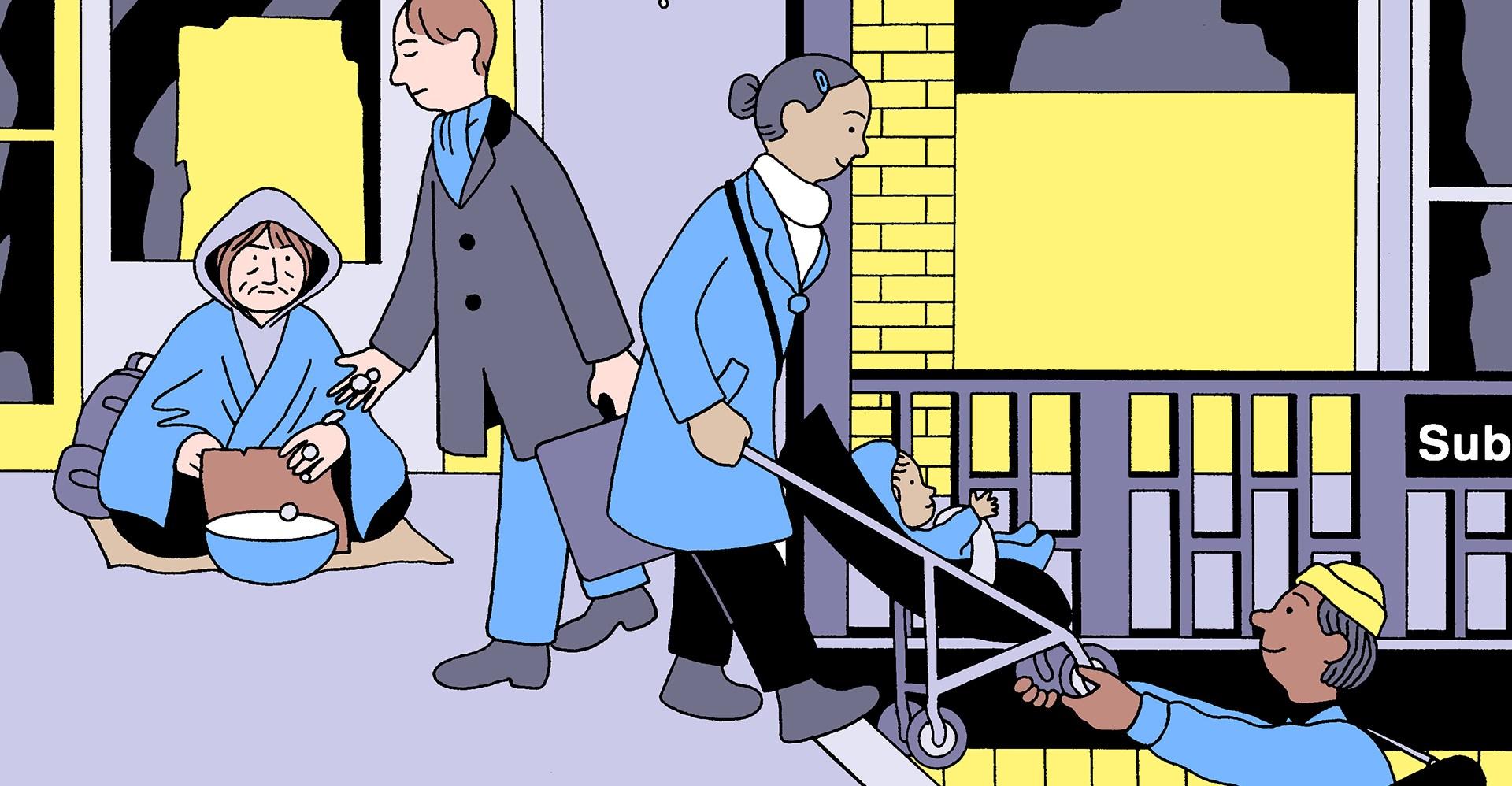
As the writer of an ethical advice column, I get a lot of questions from people who really want to do good in the world but are running into problems.
They want to know how to give charity — and how to do it optimally. They want to know if they should be pressuring their parents to donate more. They want to know if there’s such a thing as helping too much or too little. And they want to know about ways of doing good that aren’t about giving money at all.
So, in honor of Giving Tuesday, I’ve combed through all the advice I’ve given over the past year and created this cheat sheet for you. It’s packed with my top tips, as well as my favorite quotes about the philosophy of doing good.
If giving away money is hard, start small. Then, prepare to feel amazing.
I grew up in a family on welfare. We always had housing and enough to eat, but we couldn’t afford frills. I put every penny I got straight into a savings account, and my child-brain whined with anxiety when I saw my dad occasionally donate to others (what if we need that money?).
As an adult, I was lucky to get jobs that paid decently. But ,I kept grappling with money dysmorphia — feeling nervous about money even after becoming financially stable.
Tips for doing good
* Sometimes, the best way to get comfortable with giving away money is to just start giving. Don’t be shy about starting small; you can do a shocking amount of good for less than $100.
* Make use of charity evaluators that tell you which nonprofits do the most good per dollar in a given field. But give up the fantasy that some magic formula can tell you how to optimize “the good” overall.
* If you want to encourage others to donate more, meet them with empathy (not pressure or judginess) and emphasize the joy you get out of giving (not the moral case for it).
So, believe me when I say, I understand that giving away your money can be scary.
Here’s what I did: I started small. I gave $10 here, $50 there, until, eventually, I was donating thousands of dollars each year. It helped that rigorous charity evaluators had come on the scene, so I could feel confident that certain nonprofits would put my money to good use. And it helped to learn that even a modest donation can do serious good. For just $94, say, you can keep a child from starving.
To my surprise, my initial fear ended up giving way to a wild, leaping joy. Giving felt so good, not only because I knew it was helping others, but because it reminded my brain that I’m not a solitary, atomized being; I’m connected to everyone else. As weird as it may sound, Giving Tuesday actually became one of my favorite days of the year.
The British philosopher Derek Parfit once beautifully described his own experience undergoing this shift:
> I seemed imprisoned in myself. My life seemed like a glass tunnel, through which I was moving faster every year, and at the end of which there was darkness. When I changed my view, the walls of my glass tunnel disappeared. I now live in the open air. There is still a difference between my life and the lives of other people. But the difference is less. Other people are closer. I am less concerned about the rest of my own life, and more concerned about the lives of others.
Understand what you can optimize — and what you can’t.
I’m very grateful that we have charity evaluators whose entire job it is to find the nonprofits that genuinely do a lot of good with each dollar. Some nonprofits are much more effective than others trying to achieve the same goal, and all things being equal, we don’t want to blow all our money on the wildly ineffective ones.
So, optimization definitely has its place in the world of charity, and I recommend giving generously to the “best buys” for improving people’s well-being. But, I would caution you not to stretch optimization beyond its optimal limits.
If you want to optimize something, you have to be able to run an apples-to-apples comparison — to calculate how much good different things do in a single currency, so you can pick the best option. But helping people isn’t reducible to one currency; it comes down to lots of incommensurable goods. How do you compare, say, preventing malaria with alleviating depression? Saving lives versus improving them? Or saving the life of a kid versus saving the life of an adult?
There is no objective One True Answer here. How to rank these different goods depends on each person’s subjective philosophical assumptions. So, we need to give up the fantasy that there’s some magic formula that can tell us how to optimize “the good” overall.
That doesn’t mean anything goes, or that every charity is equally worthy of your money! It means the best you can do might be to consider how compelling you find the case for each one and divvy up your budget accordingly.
For example, I give about 85 percent of my charity each year to highly cost-effective organizations abroad like GiveDirectly and StrongMinds, because I know my money goes further in developing countries and I believe all lives are equally important. But, I also reserve a smaller amount for other things I value: a national homelessness organization, a social justice group, a media outlet, my meditation community, a group trying to preserve an endangered language.
Notice that some of these don’t submit easily to quantification, and some aren’t about furthering strictly “moral” goods. I think they’re important anyway.
One of my touchstones is contemporary philosopher Susan Wolf’s concept of the “moral saint” — someone who tries to make all their actions as morally good as possible.
Wolf argues that this is actually a bad ideal. We often think of “virtue” as being connected to morality, but Wolf’s point is that there are also non-moral virtues, like artistic beauty. If you ignore those, you end up bereft of the things that make up a life well lived:
> If the moral saint is devoting all his time to feeding the hungry or healing the sick or raising money for Oxfam, then necessarily he is not reading Victorian novels, playing the oboe, or improving his backhand. A life in which none of these possible aspects of character are developed may seem to be a life strangely barren.
I think that holds true both for how you spend your time and how you spend your money.
Stop seeing yourself as a “giver.” Start seeing yourself as part of a web.
I encounter a lot of people who give so much of their time and money that they become overextended and resentful. Pop psychology would say these people need to get better at asserting “personal boundaries” — at drawing a sharp line between themselves and others. But, if you believe, as I do, that we’re all actually profoundly interconnected and interdependent, then that idea of boundaries may feel like an unconvincing reason to practice self-preservation.
Instead, I think it’s better to picture yourself as part of Indra’s net. According to that classic Buddhist metaphor, an infinite net stretches out across the universe (a bit like a spiderweb). At each node where the threads intersect, there’s a jewel (a bit like a dewdrop that sits on the spiderweb). Allan Watts, an American popularizer of Eastern philosophy, described it beautifully:
> Imagine a multidimensional spider’s web in the early morning covered with dew drops. And every dew drop contains the reflection of all the other dew drops. And, in each reflected dew drop, the reflections of all the other dew drops in that reflection. And so ad infinitum. That is the Buddhist conception of the universe in an image.
Because each dew drop (or jewel) contains the image of every other dew drop (or jewel) in the entire net, none of them exists as a separate, boundaried entity. Change one, and all the others change, too.
So, if you mess up your own well-being, you’re diminishing one of these intrinsically precious bright spots. You’re also diminishing every other bright spot in the net. That is not morally praiseworthy.
Remember that others have different ways of doing good. They may be just as valid.
Giving money to charity can do a lot of good. That doesn’t mean it’s the only way to do good.
One of the most striking recognitions of this can be found in the Islamic tradition. The religion places a high premium on monetary charity, known as zakat. But, there’s another form of giving: sadaqah. The Hadith, a collection of the sayings and traditions of the prophet Muhammad, contains a poetic explanation of sadaqah:
> A sadaqah is due for every joint in each person on every day the sun comes up: to act justly between two people is a sadaqah; to help a man with his mount, lifting him onto it or hoisting up his belongings onto it, is a sadaqah; a good word is a sadaqah; and removing a harmful thing from the road is a sadaqah.
In other words, sadaqah comes in many shapes and sizes; it’s broader than mere charity. It’s what I would call solidarity. And notice how it’s arguably even more morally demanding than monetary charity. All charity requires is writing a check — an action that can be done dispassionately, and even effortlessly for someone lucky enough to have money. It doesn’t require commitment to a broader project of solidarity or justice. In fact, a common critique of charity is it can serve as a distraction from the unjust ways that wealth is created. But sadaqah requires you to be engaged, emotionally and often physically, too.
So, if you know people who don’t donate money to charity, by all means, encourage them. Research suggests the most effective way to do this is to meet them with positive regard and empathy (not pressure or judginess) and to emphasize the joy you get out of giving (not the moral case for it). But above all, don’t assume that they’re not already doing a lot of good. They may be engaged in a different but equally valid practice of solidarity.
Bonus: What I’m reading
* This helpful piece published by the Cosmos Institute adds nuance to the debate over whether we’re really “addicted” to tech. It draws on the late American philosopher Harry Frankfurt, who argued that addiction involves conflict between first-order desires (what we want in the moment) and second-order desires (what we want to want).
* The Victorians were obsessed with self-improvement and self-discipline techniques meant to bring them in line with second-order desires — and a lot of our current cultural focus on optimization can be traced back to the Victorians’ mindset. This Aeon essay explains how they turned the simple practice of keeping a diary into a “promise of total control over time, place, and the self.”
* I love this poem by Traci Brimhall, which reads like a riposte to the Victorians. Representative snippet: “Congratulations, Time. Look at you and your gorgeous minutes full of everything. Three cheers for the temp agency that hired this particular day, these particular clouds, this set of honking geese migrating through it.”

Why the right turned on Indian Americans
- 16 hours ago

The director of Fjord takes the ‘risky position’ of moderator
- 18 hours ago

Closure of Riyadh airport extended after deadly Houthi strike
- a day ago
Your kid wants to go vegan. Should you let them?
- 16 hours ago

The man who will likely be the next House speaker, explained
- 16 hours ago

Funeral prayers of two martyred officers of Mushshak crash offered at Chaklala Garrison
- 4 hours ago

Four killed as Rehman Baba Express train derails near Multan
- 6 hours ago

A week with Googlebooks: four notes from our testing so far
- 18 hours ago

Apple to unveil new smart home products, showcasing updated Siri AI
- 6 hours ago

Apple and LG leak shows new ‘tap to control’ HomeKit features
- 18 hours ago

Saudi-led coalition orders evacuation of Yemen oil facility in Sanaa ahead of operation
- 2 hours ago

Pakistan Army conducts successful test launch of hypersonic Fatah-2 extended range missile: ISPR
- 5 hours ago
You May Like




Trending