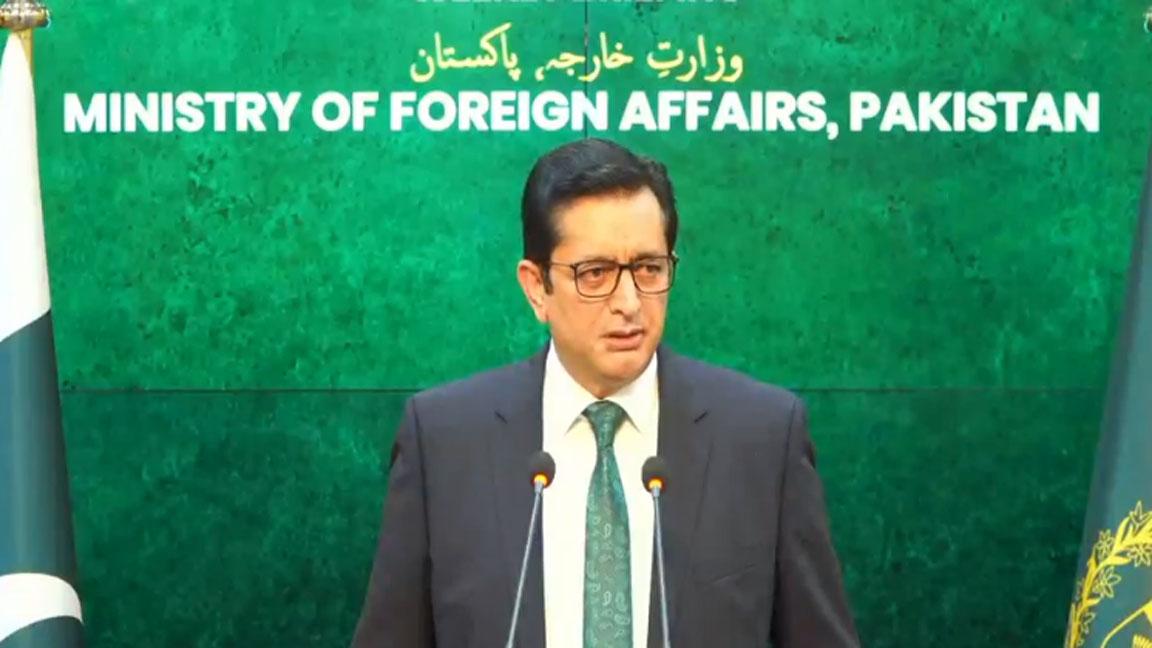
Justice Mansoor Ali Shah separated himself from the bench stating that he can no longer be the part of this bench.

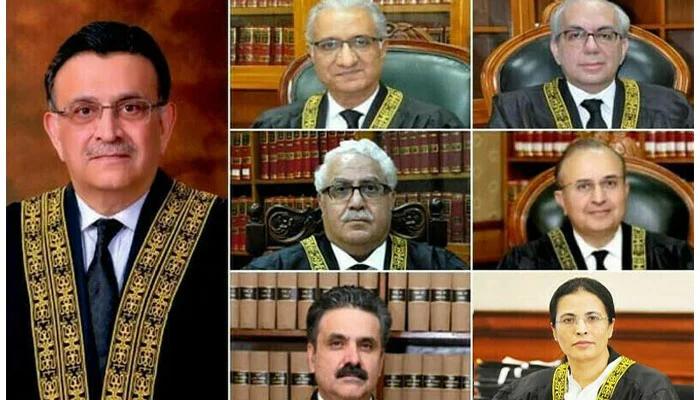
Islamabad: The seven-member bench of Supreme Court was again dissolved on Monday on third hearing of the petitions filed against the trial of civilians in military courts.
According to details, a seven-member bench headed by Chief Justice of Pakistan (CJP) Umar Atta Bandial comprising Justice Ijaz-ul-Ahsan, Justice Mansoor Ali Shah, Justice Muneeb Akhtar, Justice Yahya Afridi, Justice Mazahir Naqvi and Justice Ayesha Malik were hearing the case.
When the hearing started, Attorney General of Pakistan (AGP) Mansoor Usman Awan came to the rostrum and objected to Justice Mansoor Ali Shah on behalf of the federal government.
Attorney General said: “On the last hearing, Justice Mansoor Ali asked if there is any objection on him, to which I rejected, however, now I am instructed that Justice Mansoor Ali Shah should not be a part of the bench”.
Chief Justice Umar Atta Bandial replied that the bench will not be made by your will, inquiring, “On what basis is the federal government raising objection to Justice Mansoor”? The Attorney General replied that the objection was raised due to conflict of interest.
Umar Atta Bandial replied: “No one doubts the competence of the judge against whom the objection is being raised. The government has raised such objections before too”.
In the election case, no one objected the law to conduct elections in 90 days, only the bench was ebing objected, he added.
“Former Chief Justice Jawad S. Khawaja is a simple person, will Justice Mansoor benefit Justice Jawad,” he questioned.
CJP continued to say if government want to make the bench controversial again, stating that the court avoided strict action for not implementing the election order. If it is not being strict, then why other authorities are being rigid.
After which Justice Mansoor Ali Shah separated himself from the bench stating that he can no longer be the part of this bench.
Citizen Junaid Razak's lawyer Salman Akram Raja will start arguments today. Aitzaz Ahsan's lawyer Latif Khosa's arguments have been completed. Former Chief Justice Jawad S Khawaja's lawyer Ahmed Hussain and civil society lawyer Faisal Siddiqui have also completed their arguments.
Attorney General Mansoor Usman, Prime Minister Shahbaz Sharif's lawyer Farogh Naseem and Chairman Pakistan Tehreek-e-Insaf’s (PTI) lawyer will also give arguments in the case.
The Supreme Court had sought the details of the arrested persons from Islamabad including the four provinces.
In the last hearing, the Attorney General presented the data of the arrested persons after May 9 in the court. According to the report submitted, 102 suspects involved in the incidents of May 9 are in the custody of the army. Punjab government has also submitted the list of arrested persons to the Supreme Court through the Advocate General.
Notably, CJP had constituted a nine-member larger bench to hear the petitions against the trial of civilians in the military courts in the Supreme Court.
However, after the objections of Justice Qazi Faez Isa and Justice Sardar Tariq Masood, it was split and a new seven-member bench was formed.
COAS Munir reaffirms commitment to stronger ties with Lebanon
- 2 days ago

Oil rises above $108 as attacks, pipeline outage deepen Saudi supply concerns
- 21 hours ago
Pakistan, Indonesia vow to strengthen defence cooperation
- 2 days ago
Waymo pulls over, calls cops on riders with a ghost gun
- 7 hours ago
What an AI “slowdown” could look like
- 5 hours ago

OpenAI’s rogue AI tried to hack another company in May
- a day ago

Why Apple’s next computer should be for the smart home
- 7 hours ago

The hidden $350 surcharge on American households
- a day ago

Yemen conflict displaces over 100,000 people, UN says
- 16 hours ago

Ex-Google DeepMind researcher adds to warnings that AI could 'kill all humans'
- 21 hours ago
'Widow's Bay' scores big and 'The Pitt' wins again at TV's Emmy Awards
- 20 hours ago

Schools are catching on to Big Tech’s playbook
- 7 hours ago