IPRI roundtable calls for new provinces to improve governance, service delivery
Speakers urge adopting organic solution to Pakistan's governance issues, emphasizing that creating new provinces is crucial for public good and national security

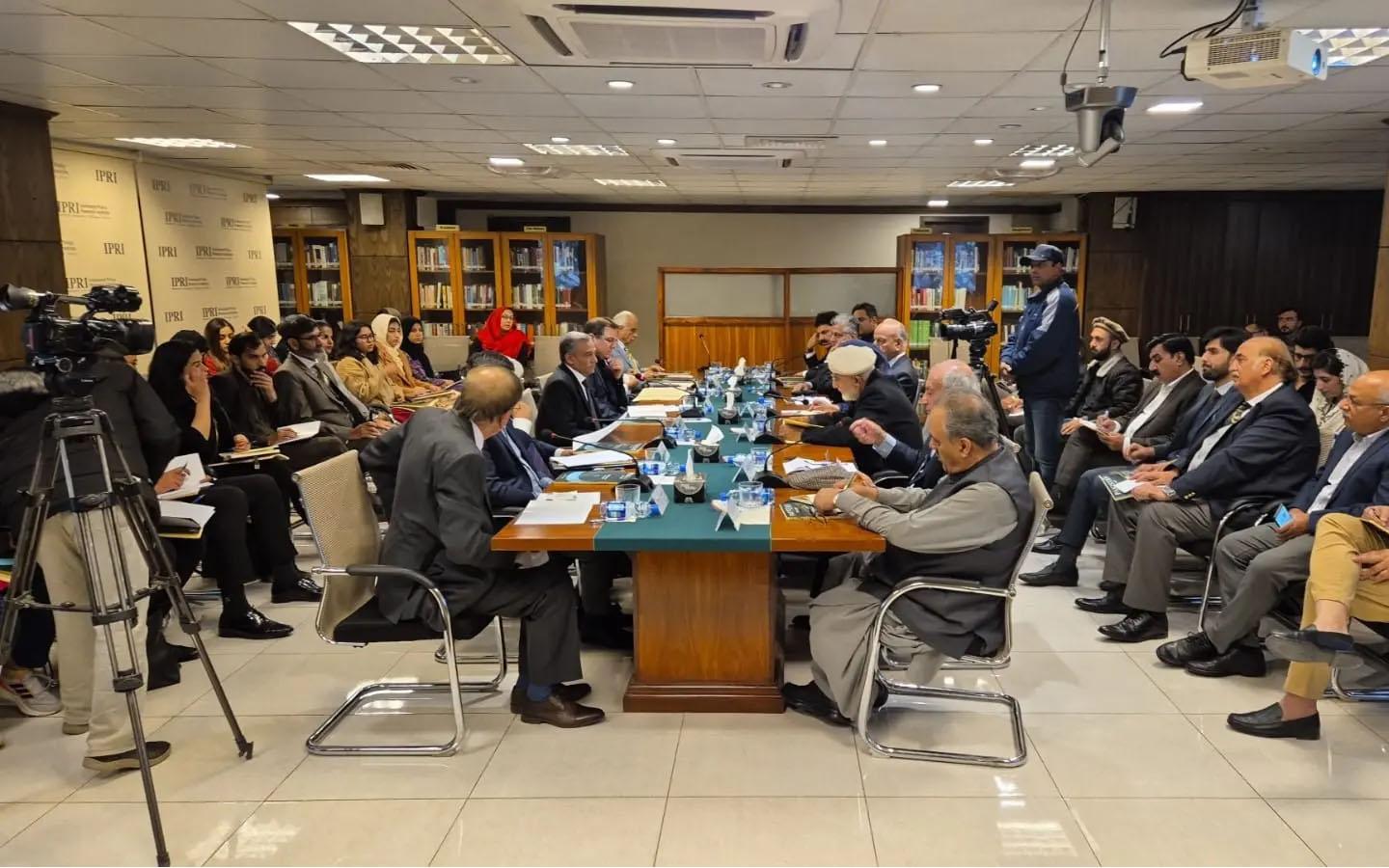
Islamabad: A roundtable discussion was held at the Islamabad Policy Research Institute (IPRI) on the need for new provinces to improve governance and public service delivery on Wednesday.
A very impressive group of politicians, public policy practitioners, academics, and media representatives attended the event.
The roundtable was addressed by Owais Ahmad Ghani, former governor of Khyber Pakhtunkhwa and Balochistan; Shakeel Durrani, Executive Director of SOPREST; Ishtiak Ahmad Khan, former federal secretary; Daniyal Aziz, former federal minister; Muhammad Hassan, former ambassador; Zubaida Jalal, former federal minister; Ambassador Asif Durrani, former special representative to Afghanistan; Hafiz Ahsan Ahmad, corporate and legal attorney; Dr. Shoaib Suddle, eminent jurist; Murtaza Solangi, former caretaker minister; and Naveed Kashif, CEO of Dunya TV.
The speakers urged the need for adopting an organic solution to the prevailing administrative and governance problems in the country and were of the view that creating new provinces is essential for the public good and national security.
It was opined that the province of Punjab is larger than 196 countries. This prompts the redrawing of boundaries and redistribution of resources if the present-day discord is to be addressed with the growing needs and necessities of a swelling population.
Some of the logical options on the table are either to convert administrative units into new provinces or merge several districts into new provinces.
It was also noted that the regional political elite is one of the biggest obstacles to this change, as they view the creation of new provinces as detrimental to their interests. Likewise, regional parties do not share the same perspective as mainstream political parties, pushing the issue into limbo. It was suggested that a viable way forward would be for Parliament to lead from the front through the formation of a commission, or more practically, the formation of a parliamentary committee to create new provinces after thorough consultations involving all stakeholders, from the media to the intelligentsia.
President of IPRI Ambassador Dr. Raza Muhammad opened the dialogue, and the discussion was moderated by Director of Research at IPRI, Dr. Raashid Wali Janjua, who highlighted the administrative, economic, and political factors that necessitate new provinces.
The participants elucidated that the delivery of public goods like law and order, civic amenities, and infrastructure development would improve significantly if the existing administrative divisions were converted into new provinces.
According to Daniyal Aziz, a very important governance element is the empowerment of people at the local government level, which would be facilitated by the devolution of powers to local governments. The downside could be the country’s departure from federalism and a transition toward a unitary polity, requiring national consensus and constitutional amendments.
According to former bureaucrats Shakeel Durrani and Ishtiaq Ahmed, the existing administrative "Divisions" could very effectively function as new provinces with manageable sizes for efficient and economical public service delivery. They stated that the bottom-up approach of governance through effective local governments, with true fiscal and political devolution of powers, would be facilitated through new provinces carved out of the existing administrative divisions of the country.
The participants of the roundtable were of the view that if countries like Afghanistan, Indonesia, and Turkey can have 34, 38, and 81 provinces, respectively, then Pakistan would also be better served with more provinces.
It was observed that the root of the problem lies in the lack of an effective local government model, which has been a victim of interference and a lack of clear schedules for demarcating powers. This has led to manipulation by senior bureaucracy, resulting in more chaos and problems. Similarly, the unclear stipulation of finances is another reason for the prevailing unrest among the administrative units.
Pakistan warns India against any misadventure: FO
- 4 hours ago

Your flu shot can’t wait
- 17 hours ago

Microsoft’s new AI chip makes it less reliant on Nvidia’s GPUs
- 10 hours ago

The Fitbit Edge is for folks who don’t want to go totally screenless
- 10 hours ago

Microsoft and Japan took down a cybercrime network behind over a billion scam messages
- 10 hours ago

KFC picks Coca-Cola as US soda supplier, ditches longtime partner PepsiCo
- 8 hours ago

Halo’s co-creator wrote a novel about AI taking over the world
- 10 hours ago

The AI race is back on
- 10 hours ago

Tesla unveils next generation Roadster sports EV with SpaceX thrusters
- 7 hours ago

Jodar apologises for swearing at ball kid in Shanghai
- 3 hours ago

Indian police detain 'cockroach' movement founder Dipke ahead of protest
- 5 hours ago

Trump is taking his midterms anger out on Ukraine
- 17 hours ago