
Takaichi received 237 votes in the lower house election to choose the next premier, topping the majority of the 465-seat chamber

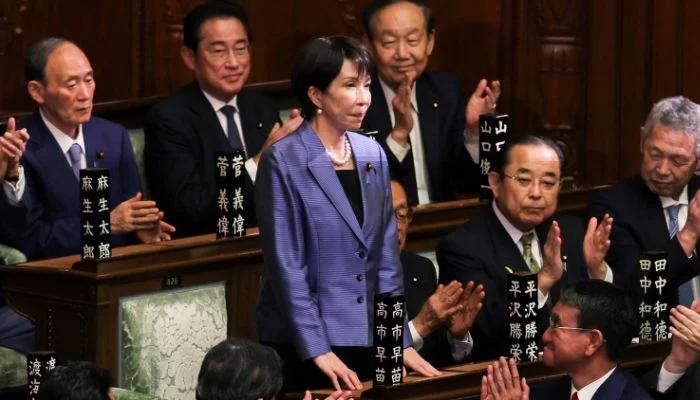
TOKYO : Hardline conservative Sanae Takaichi was elected Japan's first female prime minister on Tuesday, shattering the nation's glass ceiling and setting it up for a forceful turn to the right.
An acolyte of former Prime Minister Shinzo Abe and an admirer of Britain's Margaret Thatcher, Takaichi received 237 votes in the lower house election to choose the next premier, topping the majority of the 465-seat chamber. Her victory marks a pivotal moment for a country where men still hold overwhelming sway. But it is also likely to usher in a sharper move to the right on things like immigration and social issues.
Takaichi's victory was secured after her Liberal Democratic Party, which has governed Japan for most of its postwar history, agreed to a coalition deal with the right-wing Japan Innovation Party, known as Ishin, on Monday. After years of deflation, Japan is now grappling with rising prices, something that has sparked public anger and fuelled support for opposition groups including far-right upstarts.
Like Abe, Takaichi is expected to favour government spending to jumpstart the weakened economy. That has prompted a so-called "Takaichi trade" in the stock market, sending the Nikkei share average to record highs, the most recent on Tuesday. But it has also caused investor unease about the government's ability to pay for additional spending in a country where the debt load far outweighs annual output.
Takaichi had enough votes to get the premiership, but to govern effectively she will need the backing of more opposition lawmakers, said Tadashi Mori, a professor of politics at Aichi Gakuin University
“The two parties do not command a majority in either chamber and to ensure a stable government and gain control of key parliamentary committees, they will need to secure more than half the seats,” he said.
Any attempt to revive Abenomics could also run into trouble, Mori said, because it was devised to fight deflation.
“In today’s inflationary environment, further stimulus risks only weakening the yen. Likewise, cutting the consumption tax may spur demand, but it won’t curb rising prices.”
Takaichi was also approved by the less-powerful upper house and will be sworn in as Japan's 104th prime minister on Tuesday evening to succeed the incumbent Shigeru Ishiba, who last month announced his resignation to take responsibility for election losses.

OpenAI PR tells journalist to ‘move on’ while asking Sam Altman about a ChatGPT user’s suicide
- 15 hours ago

Trump’s “Most EXCLUSIVE DINNER IN THE WORLD”
- 13 hours ago

Bollywood actor Nana Patekar passes away at 75
- 4 hours ago

I can’t use Apple’s new Screen Time on my daughter’s iPhone because my son won’t update his MacBook
- 15 hours ago

Pakistan, IMF reach staff-level agreement for $1.2bn tranche
- 3 hours ago

Pakistan on frontlines of climate chaos despite minimal emissions: UN chief
- 8 minutes ago

The Sonos Beam 2 soundbar is $140 off
- 15 hours ago

Will Trump’s diesel order do anything?
- 4 hours ago

The two athletes in every horse race
- 13 hours ago

The Cornell case, explained
- 4 hours ago

Pakistan, Bahrain to enhance cooperation in diverse sectors
- 12 minutes ago

The real reason the Russia plague case should scare you
- 13 hours ago