The proceedings of the case were presided over by Justice Ijaz-ul-Ahsan, Justice Muneeb Akhtar, Justice Yahya Afridi, Justice Mazahir Naqvi, and Justice Ayesha Malik.

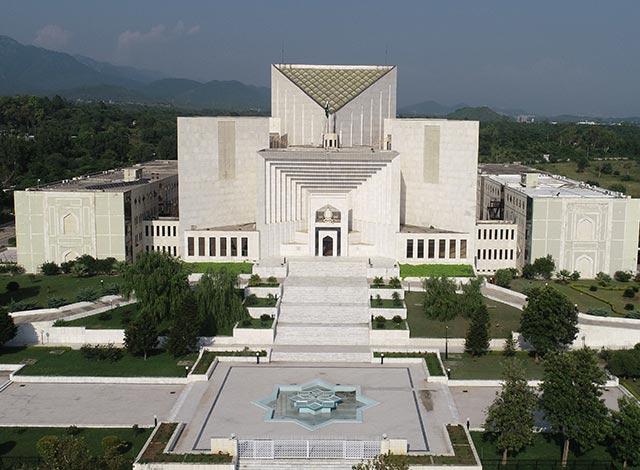
Islamabad: In a recent development the Supreme Court of Pakistan nullified the trial of civilians in military courts.
The Supreme Court of Pakistan Monday reserved its judgment in the case against the trial of civilians in military courts.
According to details, a five-member larger bench headed by Justice Ijaz-ul-Ahsan comprising Justice Muneeb Akhtar, Justice Yahya Afridi, Justice Mazahir Naqvi, and Justice Ayesha Malik heard the case.
Attorney General of Pakistan (AGP) Mansoor Usman Awan, petitioner's counsel Khawaja Ahmad Hussain, and Salman Akram Raja appeared in the court.
Lawyer Khawaja Ahmed Hussain said that some new appeals have been filed.
Justice Ijaz-ul-Ahsan stated that according to the last order, the arguments of the Attorney General were going on.
After the Attorney General completes the arguments, we will look into the way to conduct the case.
Lawyer Salman Akram Raja said that the trial in military courts was started before the decision of this case.
Justice Ijaz-ul-Ahsan added that first let the Attorney General complete the arguments and then he will listen to everyone.
Arguments of Attorney General
Attorney General Mansoor Usman Awan argued: ‘I will take time of one to one and a half hours and inform the court why military courts were created through the constitutional amendment in 2015. I will also tell why the constitutional amendment is not necessary for military courts. I will also answer the court questions during the arguments.
Justice Ijaz-ul-Ahsan inquired about the accused of 2015 who were tried in the military courts if they were civilians, foreigners, or terrorists.
Attorney General Mansoor Usman said that the suspects included both local and foreign nationals, and those who were tried in 2015 included facilitators of terrorists.
The accused shall be tried under Section 2(1D) of the Official Secret Act. It was asked how the charge be framed on the accused. The trial under the Army Act will fulfill all the requirements of a criminal trial.
The accused of the May 9 will be tried in the style of criminal court.
The reasons will be given in the decision and the evidence will also be recorded. All the requirements of transparency under Article 10A of the Constitution will be fulfilled.
Appeals can be made to the High Court and then to the Supreme Court. The 21st constitutional amendment was made because terrorists were not covered by the Army Act, he added.
Justice Ijaz-ul-Hassan inquired if the amendment was necessary for the trial of terrorists, so why not for civilians? Did the accused attack the army or the installations even at the time of the 21st constitutional amendment?
The Attorney General said the 21st Amendment included a provision for military trials of attackers in restricted areas.
Justice Ijaz-ul-Hassan asked how the trial which was not acceptable to military officers was done to others.
The Attorney General said that the issue of bias was raised in the case of modification of military courts.
How do civilians come under the ambit of the Army Act, Justice Ijaz-ul-Hassan asked.
Justice Ayesha Malik inquired the Attorney General what Article 08 of the Constitution says.
The Attorney General said that according to Article 08, legislation against fundamental rights cannot be sustained.
Justice Ayesha Malik said that the Army Act is for the establishment of discipline in the forces, how can the law of discipline in the forces be applied to civilians? How can the 21st Amendment be defended?
The Attorney General replied: “The discipline of the forces is an internal matter, obstructing the duties of the forces is an external matter, and anyone who falls under this category can be tried in the military courts”.
Justice Ijaz-ul-Hassan said that the laws you are referring to are related to the discipline of the army.
Justice Ayesha Malik asked if the provision of fundamental rights can be left to the will of the parliament. The Constitution ensures the provision of fundamental rights at all costs. How can army discipline and suspension of fundamental rights be applied to civilians? If the court opens this door, the person who breaks the traffic signal will also lose his fundamental rights. Should we interpret the constitution to suspend fundamental rights whenever he wants?
Closure of Riyadh airport extended after deadly Houthi strike
- 19 گھنٹے قبل

Agriculture Journalists Association elects new leadership
- 19 گھنٹے قبل

Apple and LG leak shows new ‘tap to control’ HomeKit features
- 11 گھنٹے قبل

FinMin Aurangzeb reaffirms support for V20's climate finance agenda
- ایک دن قبل

The director of Fjord takes the ‘risky position’ of moderator
- 11 گھنٹے قبل

Your kid wants to go vegan. Should you let them?
- 9 گھنٹے قبل
Rear Admiral Shifaat Ali Khan promoted as Vice Admiral
- ایک دن قبل
Pakistan, IMF reaffirm commitment to macroeconomic stability
- ایک دن قبل

A week with Googlebooks: four notes from our testing so far
- 11 گھنٹے قبل
The man who will likely be the next House speaker, explained
- 9 گھنٹے قبل
Why the right turned on Indian Americans
- 9 گھنٹے قبل
LUMS workshop pushes power sector indigenisation
- 19 گھنٹے قبل