
Technology
- Home
- Technology
- News
NASA finds building blocks for life in the Bennu asteroid sample
Scientists from NASA and other institutions who have been analyzing the Bennu asteroid sample that returned to Earth last September found molecules, including amino acids, which are essential ingredients of life as we know it. The sample also included “eviden…

Published 2 years ago on Feb 5th 2025, 10:00 am
By Web Desk
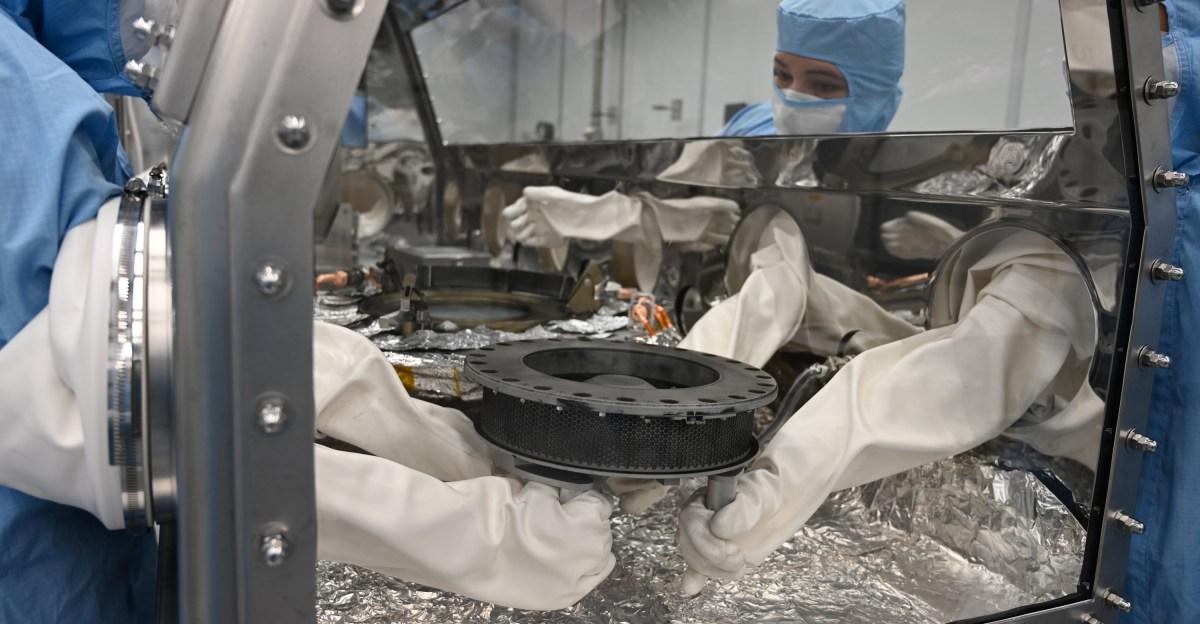
Scientists from NASA and other institutions who have been analyzing the Bennu asteroid sample that returned to Earth last September found molecules, including amino acids, which are essential ingredients of life as we know it. The sample also included “evidence of an ancient environment well-suited to kickstart the chemistry of life,” according to a NASA press release today.
The findings, published in research papers today in the journals Nature and Nature Astronomy, don’t confirm the existence of extraterrestrial life, but instead confirm the “conditions necessary for the emergence of life were widespread across the early solar system.” They also lend support to theories that the amino acids necessary for life to exist on Earth originated elsewhere, “increasing the odds life could have formed on other planets and moons.”
The research published in Nature Astronomy by NASA’s scientists revealed the Bennu asteroid sample contained 14 of the 20 amino acids used to make proteins by life on Earth, including the five nucleobases essential for the creation of DNA and RNA. NASA’s team also found an abundance of ammonia and formaldehyde which, in the right conditions, react together to form complex molecules like amino acids.
The paper published in Nature reveals evidence that those conditions may have occurred. Scientists from the Smithsonian’s National Museum of Natural History in Washington and the Natural History Museum in London found traces of 11 minerals including calcite, halite, and sylvite, indicating a history of saltwater on the larger 4.5 billion-year-old asteroid where Bennu originated, which could have helped the ingredients of life to interact and combine.
NASA’s OSIRIS-REx spacecraft launched on September 8th, 2016 and rendezvoused with the near-Earth asteroid Bennu on December 3rd, 2018. It spent almost two years studying the asteroid before touching down on the asteroid and grabbing a sample on October 20th, 2020. That sample was sealed in a protective capsule and sent back to Earth where it was successfully retrieved on September 24th, 2023.

Can this Democrat crack the code for universal healthcare?
- 7 hours ago

Bollywood actor Tiger Shroff shot at in Mumbai, three suspects held: police
- a day ago

The radical Democratic plan to change the government for good
- 7 hours ago

Security of Haramain al-Sharifain non-negotiable: DG ISPR
- a day ago

FinMin Aurangzeb reaffirms commitment to export-led economic growth
- 7 hours ago

Field Marshal, Saudi envoy discuss regional security dynamics
- a day ago

Jesse Eisenberg, Julianne Moore bring curtain down on London Film Festival with 'The Debut'
- 7 hours ago

UK to deploy RAF Typhoon jets to defend Saudi cities from Houthi attacks
- 7 hours ago

CDF Munir arrives in Tehran for talks with senior Iranian officials
- 5 hours ago

Communism in China and the changing world: from capitalist critique to socialism with Chinese characteristics
- a day ago

Army officer martyred, four terrorists killed in Balochistan operations: ISPR
- a day ago

Musk says will give SpaceX share to 'every kid in America'
- a day ago
You May Like






Trending