Wildfires on Maui have razed buildings and forced people to evacuate. What made them so devasting?

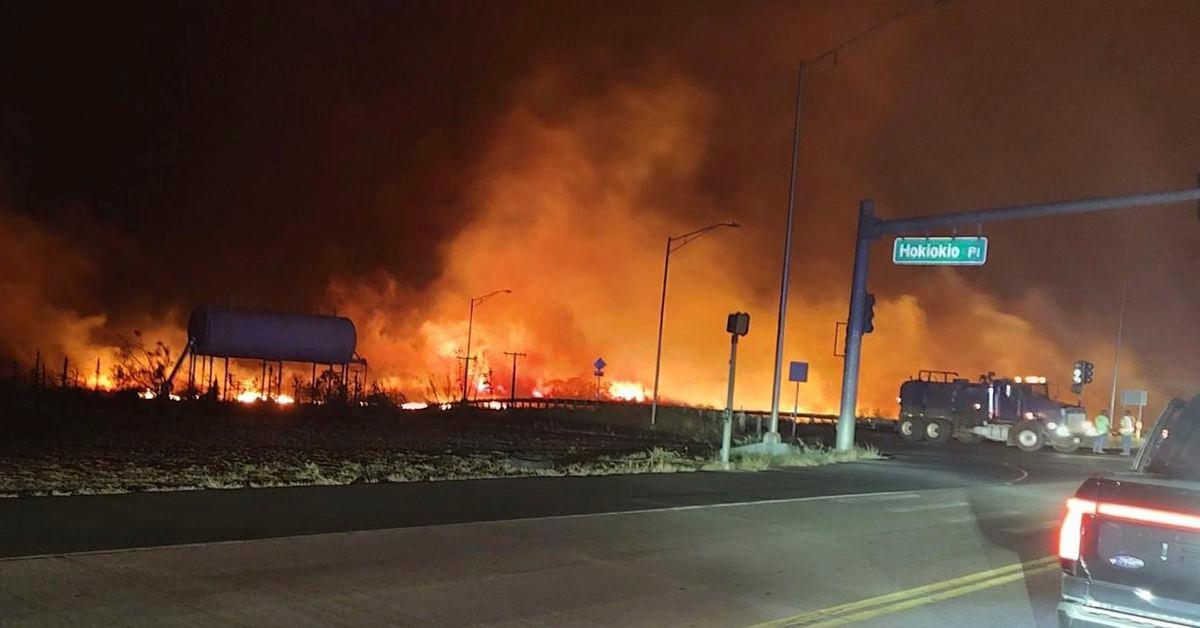
Earlier this week several wildfires engulfed parts of the Hawaiian island of Maui, killing at least three dozen people, burning multiple homes and businesses, and forcing more than a dozen people to flee into the ocean for safety.
Numerous brush fires have burned hundreds of acres in Hawaii and utterly decimated Lāhainā, the tourism heart of the island and the largest city in its west. Hospitals are overrun with burn patients, thousands of people have lost power, and as of Wednesday morning, 911 service was down.
“We have suffered a terrible disaster,” Hawaii Gov. Josh Green said Wednesday. “Much of Lāhainā on Maui has been destroyed and hundreds of local families have been displaced.”
The scene in Lahaina, Maui this morning is absolutely devastating.
The entire town is being destroyed by an intense wildfire, forcing residents to sheek shelter in the ocean.
Make no mistake, climate change is making scenes like this more frequent. pic.twitter.com/dttFnAwEeJ
Wildfires were once rare in Hawaii, largely ignited by volcanic eruptions and dry lightning strikes, but human activity in recent decades has made them more common and extreme. The average area burned each year in wildfires, which tend to start in grasslands, has increased roughly 400 percent in the last century, according to the Hawaii Wildfire Management Organization, a nonprofit group.
Part of the problem is that climate change is making Hawaii drier, so it’s more likely to ignite when there’s an ignition event (most Hawaii wildfires are sparked by humans, though the source of the current blazes is unknown). The spread of highly flammable invasive grasses is also to blame. Native to the African savanna, guinea grass and fountain grass, for example, now cover a huge portion of Hawaii, and they provide fuel for wildfires, as Cynthia Wessendorf has written in Hawaii Business Magazine.

These factors are at play today, as is a storm hundreds of miles away. Here’s why these fires have become so intense so quickly.
Hawaii is dry right now and getting drier
The simplest reason why parts of Maui are burning is that it’s hot and dry — summer is the dry season. And dry, hot weather provides the foundation for extreme wildfires by sucking moisture out of vegetation and essentially turning it into kindling. (That’s partly why the Canada wildfires have been so severe this year, too.)
Zooming out, carbon emissions from burning fossil fuels are making the planet hotter and deepening droughts around the world. Hawaii is no exception. Today, there’s less rainfall in 90 percent of the state compared to a century ago, according to the state government.
Winds from a major hurricane sweep through Maui
The wildfires burning today are also made worse by a powerful hurricane churning hundreds of miles offshore in the Pacific Ocean. Although Hurricane Dora is not expected to make landfall in Hawaii, it’s pushing strong winds that can, in turn, fuel wildfire blazes, according to the National Weather Service.
The winds not only help fire spread quickly but make it difficult for firefighters to put them out. Heavy gusts can knock down trees near roads, blocking access to certain regions, and can also ground helicopters that dump water to quell the blaze. It’s an important example of how hurricanes and wildfires — both of which are set to become more extreme under climate change — interact with each other.

There is more fuel for fires to burn
The last reason has less to do with climate and more to do with ... grass.
Unlike fires on the mainland — which are large and spread in forests, burning hundreds of thousands of acres in a given year in places like California — those in Hawaii are typically small and ignite in grasslands. They tend to burn something on the order of tens of thousands of acres a year across the state.
But over the last century or so, humans introduced a variety of nonnative grasses to the state, such as guinea grass, which is often used as feed for livestock. These plants are known to outcompete native grasses, and they grow incredibly quickly after rainfall, which can produce an enormous amount of fuel for wildfires.
New video from Front Street shows virtually all of downtown Lahaina has been burned down. pic.twitter.com/i4ViDhz8K7
— Colin McCarthy (@US_Stormwatch) August 9, 2023Today, nonnative grasslands and shrublands cover nearly one-quarter of the land area in Hawaii, according to the Hawaii Wildlife Management Organization. “Together with a warming, drying climate and year-round fire season,” the group said, the nonnative grasses “greatly increase the incidence of larger fires.”
The good news is that Hurricane Dora is traveling west, away from Hawaii, and so winds are likely to slow later today and over the rest of the week. Better weather has also made it possible to send up helicopters to control the blazes. That should bring some relief. Yet bigger climate trends point to hotter and drier summers — which could lead to even more destructive fires in the years to come.
Update, August 10, 9 am ET: This story, originally published August 9, has been updated with current mortality and damage estimates.

The director of Obsession put a new horror short on YouTube
- a day ago

You like your job. AI is better at it. What now?
- 2 days ago

Gold prices plummet in Pakistan , global markets
- 2 days ago

Are you over-optimizing your hobbies?
- 6 hours ago

Patrick Stewart taught us what good men do with power
- 21 hours ago

Everything announced at Amazon’s October 2026 hardware launch
- a day ago

The case for a little election optimism
- 2 days ago

Our first look at Amazon’s big new Echo Show 16
- 8 hours ago
Is this our last time setting our clocks back?
- a day ago

Iran's supreme leader warns US, Israel against new attacks
- 2 days ago

Kamindu hits maiden ODI ton as Sri Lanka set Pakistan 326 in final
- 2 days ago

Pakistan committed to defence of KSA, Harmain Sharifain: DG ISPR
- 2 days ago